Cartilage piercing has moved from a niche subculture to a mainstream ear-styling habit, and with it has come a steady demand for small hoops that sit in the helix, rook, tragus, and daith. Customers no longer buy one pair of studs; they build a curated row of piercings, and that means repeat purchases of tiny hoops in different finishes and decorations. For resellers, cartilage hoops are one of the most dependable repeat-buy earring categories available at budget price points.
Why cartilage hoops are a repeat-buy category
Unlike a pair of everyday studs that lasts years, cartilage hoops get changed out the way people change rings. Customers collect them, mix gold and silver across multiple piercings, and swap with outfits. A buyer who starts with one helix piercing often adds more over time, which keeps the order pipeline open. That repeat behavior is the core of why the category rewards consistent stocking rather than one-off buys.
The sizing reality also works in the reseller's favor. These are tiny pieces using almost no metal, so landed cost stays low while the specialty perception supports a solid retail price. The same economics that make hoop earrings by size profitable scale down neatly to the cartilage range.
Sizing and gauge: the details that matter
Cartilage hoops are defined by two numbers: the gauge (thickness of the post) and the inner diameter. Most healed cartilage piercings use a 20-gauge or 18-gauge post. Stocking a 20-gauge hoop covers the largest share of buyers; an 18-gauge option handles the rest. Going finer than 20 risks bending; going thicker blocks most people's existing piercings.
Diameter is where fit varies by piercing location. A helix piercing typically takes a 6mm or 8mm inner diameter, while a tragus or daith often needs a tighter 6mm. A 5mm hoop disappears on a helix; a 10mm hoop hangs awkwardly on a tragus. Offer a small ladder — 5mm, 6mm, 8mm — and let customers match to their piercing. This is the single most common reason for returns, so describe diameters clearly on every SKU.
Closure types that survive daily wear
A cartilage hoop that opens at the wrong time is a lost hoop, and lost hoops are the top complaint. The three common closures are the hinged click-together segment ring, the fixed-segment ring that pops open sideways, and the small snap hoop. The hinged click-together version is the safest for everyday wear and the easiest for customers to manage one-handed.
Avoid screw-back ball closures for cartilage hoops; they are fiddly and the ball is easily lost. Inspect the hinge on samples — a loose hinge gap means the hoop will not click shut securely. For the broader hardware picture, our guide to earring back types and security explains the tradeoffs across earring styles.
Materials: skin contact raises the bar
Cartilage piercings take longer to heal than earlobe piercings and are more sensitive to irritants. Even healed piercings sit in skin longer than a stud does, so nickel content matters more than it does for normal fashion earrings. For a budget line, plated alloy on a brass base is the commercial reality, but confirm nickel release meets current limits, and steer customers who are newly pierced toward implant-grade options rather than plated fashion pieces.
Rhodium finishes wear better than gold on cartilage because the hoop rotates constantly against the ear and sees friction. Bright polished metal also shows off small stone accents better. Our explainer on hypoallergenic earrings for sensitive ears sets the baseline you should communicate on product pages.
Designs that sell
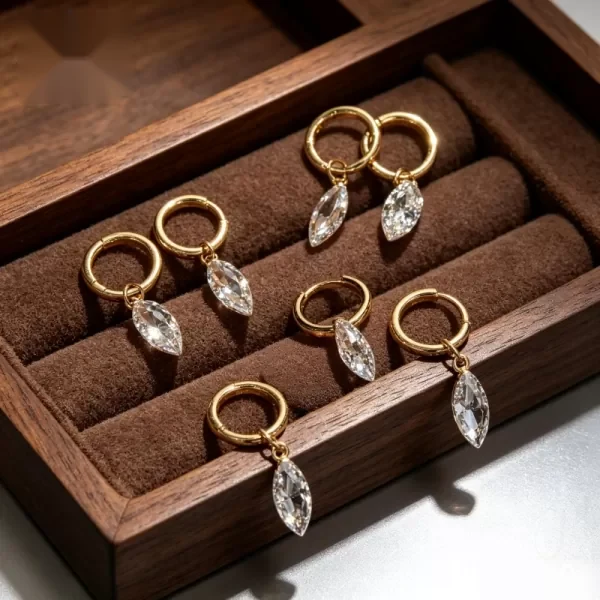
The top sellers are the tiny plain polished hoop in gold and silver, the micro CZ-set hoop with one small stone, and the hinged hoop with a tiny charm or dangling drop. Keep the decoration proportional: a hoop under 8mm cannot carry a large stone without looking heavy. The minimalist plain hoop is the workhorse; the stone-set version is the upsell.
Bundle three small hoops in different finishes as a "curated ear set" to lift average order value — the same impulse logic behind stud earring curation. Merchandize on an ear model or a card showing a fully styled ear so customers can picture the whole look.
Merchandize the full ear journey. A customer who buys a cartilage hoop rarely stops at one; she is building a curated ear across lobes, helix, and tragus. That makes the category a natural cross-sell engine with our broader budget earrings line. Suggest a stud for the lobe and a small hoop for the helix in the same finish, and the single purchase becomes a three-piece order.
Bottom line
Cartilage hoops are a repeat-buy, low-cost, high-margin niche for earring resellers. Get the gauge and diameter ladder right, prefer hinged click closures, specify compliant materials, and merchandize them as a curated ear. Done well, customers come back every time they add a piercing.
For the legal text behind our material compliance, see the REACH Regulation (EC) No 1907/2006 on EUR-Lex.
Frequently Asked Questions
What ring sizes can you supply in bulk?
US sizes 5–12 including half sizes. Send a size breakdown with your order and we cast to that curve; comfort-fit inner bands reduce resize requests.
Can I order a mixed size run instead of one size?
Yes. Mixed runs are standard for wholesale: specify quantity per size and we pack and label by size at no extra labor cost.
What is the MOQ for custom ring designs?
50 pieces per design for existing molds; 100–300 pieces when a new mold or CAD model is required.
How should I price rings for retail margin?
Most partners use a 3–4x markup on FOB cost for sterling and 2.5–3x for moissanite solos, which keeps landed cost under 30% of retail.