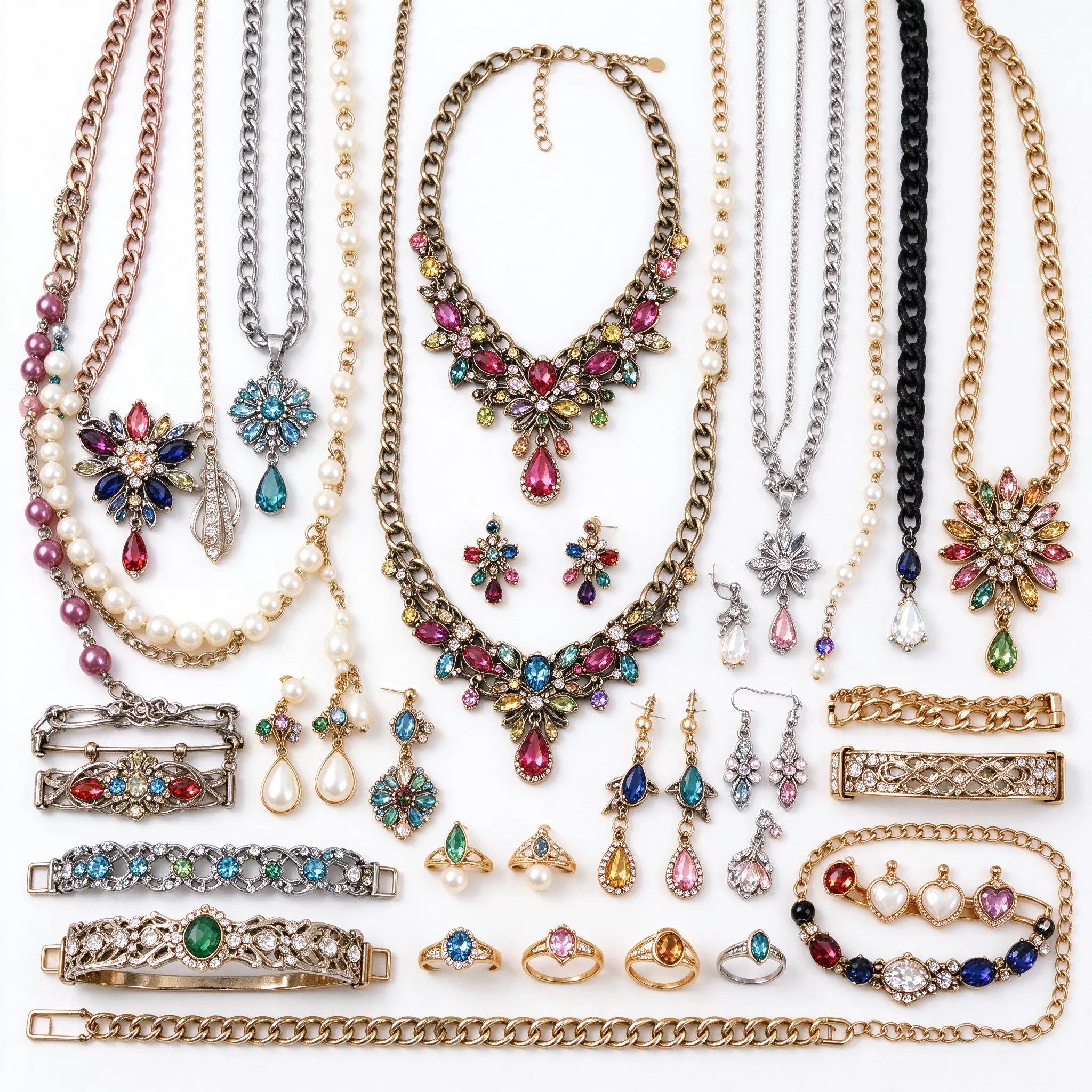
Pricing a mixed jewelry lot is not the same as pricing a single product. In a custom order you know exactly what each piece cost and price it accordingly. In a mix lot, the carton arrives as one lump cost, and you have to work out what to sell each piece for. Price it wrong and you either leave money on the table or scare customers away. This guide explains how to cost a mixed lot correctly, tier your retail prices, bundle the slow pieces, and make sure the whole carton is profitable even if part of it never sells at full price.
The core mistake is treating every piece in the lot the same way. A necklace that cost you $2 and a pair of earrings that cost you $0.50 are not the same product, and they should not be priced as if they were. Good mix lot pricing starts by allocating the carton cost back to each category, then pricing each category on its own merits.

Start with your true landed cost
The price you paid per piece is not your real cost. Add in shipping, import duties if any, packaging and your time to sort. A lot that cost you $300 for 200 pieces looks like $1.50 each, but after a $60 shipping bill and the time spent sorting, the real cost is closer to $1.90 each. Always price from the fully landed cost, not the ex-factory price. Buyers who forget shipping wonder why their mix lots never seem as profitable as the invoice suggested.
If you used a coupon or got a discount, do not bank on it next time. Price as if you paid the normal price, so that when the discount is gone you are still profitable. Optimism about future discounts is how margins quietly erode.
Allocate cost by category, not equally
A mix lot is rarely evenly valued. The ten necklaces in the carton cost the factory far more to make than the fifty pairs of earrings. Allocate your total carton cost proportionally: if the lot is mostly earrings, the earrings bear most of the cost. A rough but workable method is to ask the factory for the retail reference value of each category in the lot, and allocate your cost in the same proportion. That gives you a realistic cost per piece by category.
Once you know the real cost of a necklace versus an earring, price each category on its own multiple. Earrings can carry a high multiple because they are cheap and impulse-priced. Necklaces need a more modest multiple because the customer expects to pay more and compares prices. The point is not to under-price the necklace just because the lot was cheap overall.
- Earrings: cost $0.50-$1.00, retail $5-$10.
- Bracelets: cost $1.00-$2.00, retail $10-$18.
- Necklaces: cost $2.00-$4.00, retail $15-$30.
- Rings: cost $0.80-$1.50, retail $8-$15.
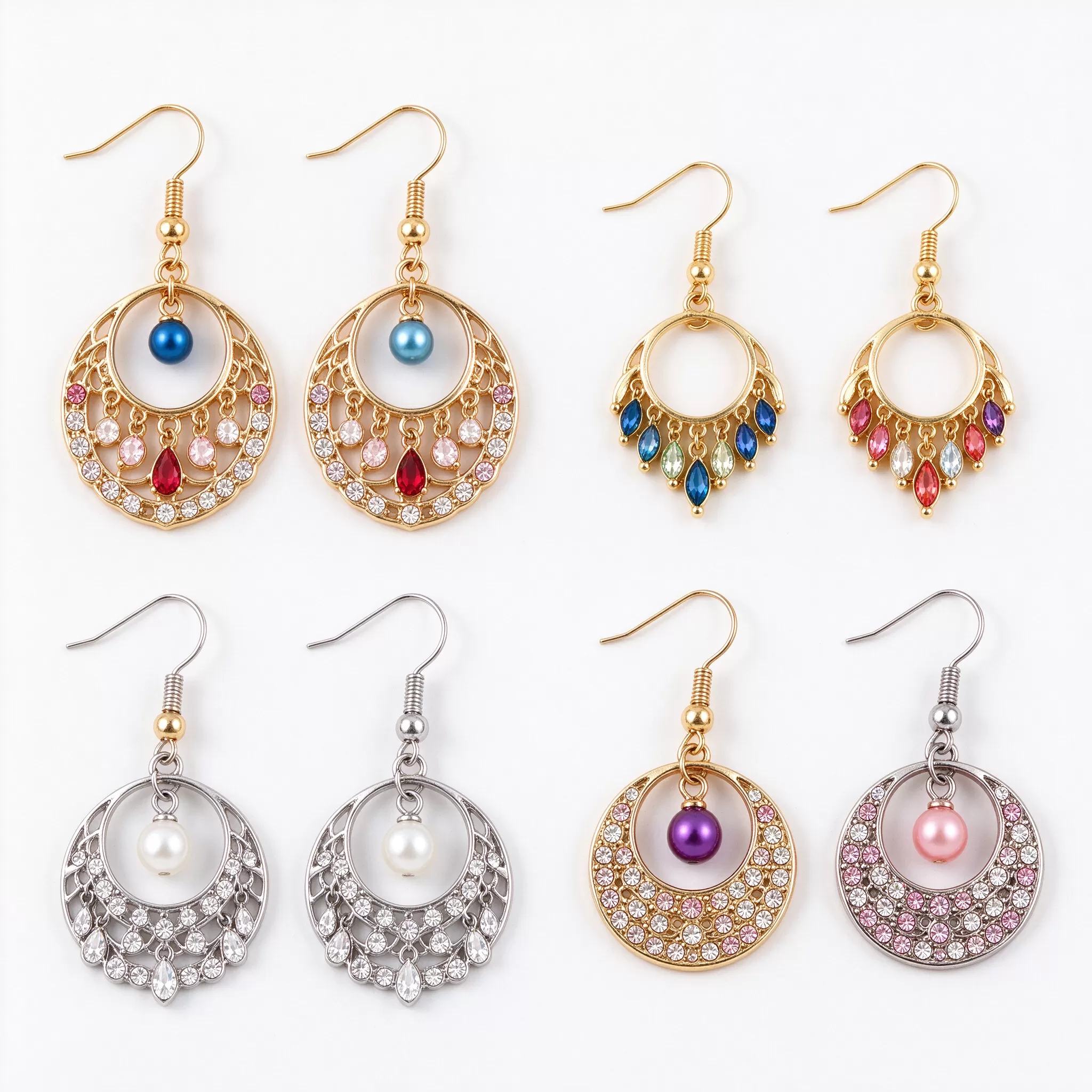
Tier your retail prices for the whole lot
Within the carton, pieces are not equal quality either. Sort them into a good tier and a basic tier. The good pieces go out at full retail on the main display. The basic pieces go out at a friendlier price on a value rail. This lets you capture margin where the product deserves it and move volume where it does not. A flat one-price approach either under-prices the good pieces or over-prices the basic ones.
Keep the price ladder tight and obvious. Customers should see a $5, a $10 and a $15 tier and immediately understand the choice. A confusing spread of random prices makes people hesitate. A clean three-tier ladder sells more total units because decision-making is easy.
Bundle the slow pieces
Some pieces will not sell individually at any reasonable price. Bundle them. Three pairs of slow earrings become a grab bag at $12. Two slow bracelets become a set at $20. Bundling turns dead inventory into an impulse buy and recovers most of your cost. The customer feels she is getting a deal; you clear space. Never price a slow piece at full price and wait; bundle it and move on.
Bundling also lifts average order value. A customer who came for one necklace leaves with the necklace plus a grab bag she did not plan to buy. That extra sale is pure margin, because the bundled pieces were already costing you shelf space.
Know your break-even on the whole carton
Before you even price individual pieces, work out the sell-through rate at which the whole carton breaks even. If the lot cost you $300 and your average retail is $10, you need to sell about forty pieces at full price to break even, and the rest is profit. That number tells you how aggressive to be on discounts. Once you have covered the carton cost, every remaining piece is nearly pure margin, which means you can discount the last half hard without losing money.
This calculation is freeing. It removes the fear of discounting. Once break-even is reached, marking slow pieces down to $3 instead of $5 is not a loss; it is turning already-recovered cost into extra cash. Most buyers discount too late because they never calculated break-even.
- Calculate carton break-even before pricing.
- Discount freely once cost is recovered.
- Bundle pieces that will not sell solo.
- Never let slow pieces occupy prime shelf after break-even.

Avoid the under-pricing trap
Because mix lots feel cheap, buyers often under-price. A necklace that cost $2 gets priced at $8 because it "only cost a couple of dollars." But that necklace would normally retail at $20 if bought individually. Price it against what customers will pay for the product, not against what it cost you in the lot. Your cost is sunk; the market sets the price. Under-pricing a good piece leaves hundreds of dollars on the table over a season.
The opposite trap is over-pricing the filler. A plain earring that you would never buy again should not sit at $8 hoping for a miracle. Price it at $3 and let it go. Over-pricing filler is how a carton ends up half-unsold a year later.
Price to your customer, not to a formula
Every market prices differently. A market stall in a small town cannot charge the same as a boutique in a city center. Know what your own customer will pay and price within that range. The multiple on cost is a guide, not a rule. If your customer will pay $15 for an earring that cost you $1, take it. If she will only pay $5, take that. The goal is the price that sells through fastest at the best total margin, not a perfect mathematical multiple.
Psychology of the price ladder
Customers decide what to buy based on the prices around it. If your cheapest earring is $5 and your most expensive is $25, the $12 middle piece looks like the sensible choice. That middle tier is where most sales happen. When you price a mix lot, deliberately build that ladder. Put one or two pieces at a low price as the "entry" anchor, a cluster at the middle, and one or two hero pieces at the top. The middle sells because the top makes it look reasonable. Price every piece in isolation and you lose that psychology.
The price endings matter too. A $9 earring reads as cheaper than $10 even though the difference is a dollar. Use charm prices at $5, $9, $15 and $19 rather than round numbers. This is not a gimmick; it measurably speeds up impulse purchases on low-ticket jewelry.
Marking down without devaluing the brand
Discounting a whole mix lot at once can cheapen your shop. Instead, discount tactically. Keep the main display at full price and run a separate clearance corner where the slow pieces live. Customers understand a clearance rail without feeling that everything in your shop is cheap. Never put a sale sign across the whole store just to move a tail lot; that trains customers to wait for discounts.
Time the markdowns. Do not discount on day one. Let pieces sell at full price for six to eight weeks first. Then mark the slow ones by thirty percent, then fifty percent if they still sit. A graduated markdown is more profitable than slashing everything immediately, because some pieces will sell at full price if you only give them time.
Accounting for returns and breakage
When pricing a mix lot, remember that not every piece will be sold, some will be returned, and a few will break in the shop or in transit. Build a small reserve for this. If twenty pieces out of two hundred will not sell or will be returned, price the remaining hundred and eighty to cover the whole carton cost. Buyers who price every piece as if it will sell cleanly end up short when reality intervenes. A ten percent reserve for loss and return is prudent and keeps your margins honest.
- Build a clear price ladder with a crowded middle.
- Use charm prices to speed impulse buys.
- Discount on a separate rail, not across the whole shop.
- Reserve ten percent for returns, breakage and unsold stock.
Testing price points on real customers
A mix lot is a live pricing experiment. Because you have many pieces at similar cost, you can test what price your market will bear. Put identical earrings out at $8 and $12 on different days and watch which sells faster. The answer tells you your market's ceiling. Most new buyers price too low because they are unsure, and the mix lot is the safe place to discover that customers will actually pay more. Raise the price, watch the sell-through, and find the sweet spot where margin and turnover meet.
This testing is free because the pieces are already in the carton. Use it. The price you settle on after testing will become the price you use on your custom orders, where the margin is higher anyway. The mix lot thus pays for itself twice: once in the sales, and again in the pricing intelligence it gives you.
Price the whole carton, not each piece
Mix lot pricing is a whole-cartoon math problem solved piece by piece. Start from your true landed cost, allocate it by category, tier the good and basic pieces, bundle the slow ones, and know your break-even. Price against what the customer will pay, not against what the lot cost. Done this way, even a mix lot with thirty percent filler can be highly profitable, because the winners carry the margin and the fillers move cheaply and fast. The lot was cheap; your pricing should be smart. Revisit the numbers after every carton and you will steadily learn the exact price points your market rewards, which is knowledge that transfers straight onto your higher-margin custom orders. Keep a simple pricing log as you go, and within a year you will know your market's price ceiling for every category without having to guess. That log is one of the most valuable assets a small jewelry buyer owns, because it turns instinct into a repeatable rule. Price boldly, discount strategically, and never confuse a low cost price with a low selling price. Your customers pay for the piece, not for the deal you got, and pricing it that way is how a cheap carton turns into serious margin.
