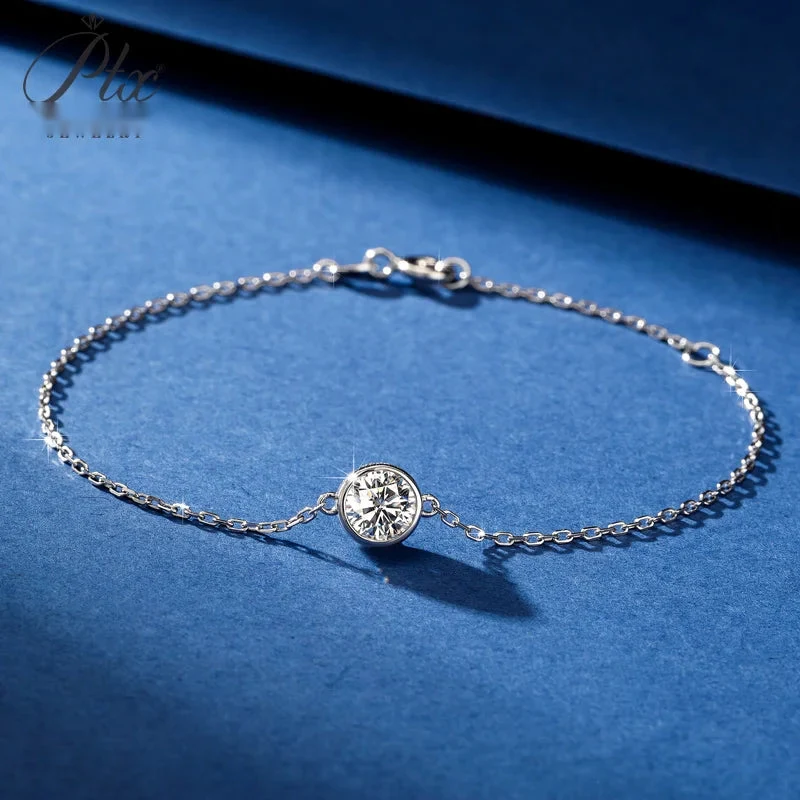
A UK-based demi-fine jewelry brand launched a moissanite tennis necklace program in early 2025 through another manufacturer. The sample looked beautiful—continuous 3mm stones, clean channel setting, bright rhodium finish. They placed an order for 600 necklaces in 925 silver. When the bulk shipment arrived, they discovered problems: 23% of necklaces had at least one stone that was set slightly high or low, creating visible gaps and uneven sparkle; 14% had links that did not flex smoothly (stiff sections that prevented the necklace from lying flat); 8% had clasps that stuck or did not close securely; and the rhodium plating wore off on 11% of necklaces within two weeks of customer wear. Their return rate hit 18% and they pulled the product. They came to us in May. We reverse-engineered the design, identified the root causes (stones were set without seat-level jigs, links were cast from old molds with worn pins, clasp components were cheap stamped parts, and rhodium plating was applied at 0.2 microns), and produced a replacement run of 800 necklaces. Their return rate on our production has been 0.7% across three reorders.
Moissanite necklaces—particularly tennis necklaces—look like a simple extension of tennis bracelet design, but they present unique manufacturing challenges that many factories underestimate. A tennis bracelet has 40-55 stones on a flexible 7-inch piece; a tennis necklace has 120-180 stones on a 16-18 inch piece that must drape around a curved surface, flex through all neck movements, and lay flat without gaps or twisting. Every additional stone adds another point of potential failure; every additional link adds another point of stiffness or weakness. This guide explains how professional moissanite necklace manufacturers approach production, the specific engineering challenges of necklaces (especially tennis necklaces), and the quality controls that separate durable necklaces from pieces that disappoint.
Why Necklace Manufacturing Is More Complex Than It Appears
Several factors make moissanite necklace production significantly more challenging than rings, earrings, or pendants:
Stone count and alignment. A 16-inch tennis necklace with 3mm stones contains approximately 140 individual stones. Each stone must be set at exactly the same height, at exactly the same angle, with exactly the same amount of metal visible around it. Even a single stone set 0.05mm high creates a visible bump in the line of sparkle. A stone set 0.05mm low creates a visible gap. This requires setting jigs, precise seat depth control, and individual height measurement for every stone—a process that adds significant labor cost but is essential for a quality piece.
Flexion across three dimensions. A bracelet flexes primarily in one plane (around the wrist). A necklace drapes in three dimensions around the neck—curving left to right, front to back, and conforming to the collarbone. Links must be engineered to flex smoothly in all directions without binding, without creating gaps between stones when the necklace is worn, and without putting stress on settings during movement. Link geometry that works for a bracelet often fails for a necklace because the flexion requirements are different.
Weight distribution. A 3mm tennis necklace in silver weighs approximately 18-25 grams; in 14K gold, 35-45 grams. That weight is distributed across the chain but pulls most heavily at the back of the neck where the clasp sits. Clasps must support the full weight of the necklace without opening accidentally. Links at the back must be reinforced to handle the concentration of weight. Necklaces that are too heavy for their link gauge stretch over time, creating gaps between settings.
Lay-flat requirement. A necklace that does not lay flat against the skin twists to one side, creates gaps between sections, or flips over to show the reverse. Lay-flat performance depends on link tension balance, clasp weight balance, and overall weight distribution. Testing lay-flat requires placing the necklace on a curved neck form (not just a flat table), because a necklace that lays flat on a table may twist when draped on a curved surface.
Length consistency. Necklace length determines where the piece sits on the wearer's chest. A 16-inch necklace that comes in at 15.5 inches sits higher on the neck than expected; a 16-inch that comes in at 16.8 inches sits lower. Length must be measured under slight tension (the way the necklace hangs when worn) rather than laid loose on a table, because loose measurement adds slack length from kinks in the links. GIA standards for gemstone setting apply to necklace stones as to all jewelry, with the added requirement of consistent height across dozens to hundreds of stones. Explore our moissanite necklace production capabilities.
Moissanite Necklace Style Comparison
Different necklace styles carry different manufacturing complexity and pricing:
| Necklace Style | Stone Count (16") | Silver Unit Price (50pc) | Gold Unit Price (50pc) | Key QC Focus | Defect Risk |
|---|---|---|---|---|---|
| Solitaire pendant on chain | 1-3 stones | $18-$35 | $85-$160 | Bail strength, chain quality | Low |
| Halo pendant on chain | 1 center + 16-30 melee | $32-$55 | $130-$220 | Melee security, bail | Low-Medium |
| Tennis necklace (channel, 3mm) | ~140 stones | $95-$165 | $480-$780 | Stone alignment, link flex, clasp | Medium-High |
| Tennis necklace (prong, 3mm) | ~140 stones | $110-$185 | $520-$850 | Prong security, stone snagging | High (prong catch) |
| Tennis necklace (bezel, 3mm) | ~140 stones | $120-$200 | $540-$900 | Bezel wall consistency | Medium |
| Tennis necklace (2mm slim) | ~200 stones | $80-$140 | $420-$680 | Delicate link strength | High |
| Tennis necklace (5mm statement) | ~85 stones | $160-$280 | $780-$1,200 | Weight, clasp strength | Medium |
| Rivière necklace (graduated) | 60-100 stones (graded sizes) | $130-$240 | $650-$1,100 | Graduated size sequencing | Medium-High |
| Station necklace (Y-neck, etc) | 5-20 stones spaced on chain | $40-$80 | $180-$380 | Station positioning, chain | Low-Medium |
Prices shown for D/VVS1 moissanite in 925 silver with rhodium or 14K white gold with rhodium. Yellow and rose gold versions are typically 5% less than white gold (no rhodium plating step). Tennis necklaces are the most technically demanding category in this list due to the combination of high stone count, complex flexion requirements, and clasp engineering. We produce more tennis necklaces than any other necklace style and have refined our production process across thousands of pieces. Learn about our necklace manufacturing facility.
Tennis Necklace Link and Clasp Engineering
The two most common failure points in tennis necklaces are link stiffness/breakage and clasp failure. Both are engineering issues that require specific design choices:
Link design. Tennis necklace links connect individual settings (or groups of settings) in a flexible chain. The two dominant link designs are cup-link (each stone in its own cup, connected by small pins between cups) and bar-link (stones set into continuous channel bars of 3-7 stones, connected by flexible links between bars). Cup-link construction is more flexible and classic in appearance but has more connection points that can loosen over time. Bar-link construction creates a cleaner, more modern line and has fewer connection points, but individual bar links must flex on their connecting pins without binding.
We use bar-link construction for most of our production tennis necklaces, with 3-5 stones per bar depending on stone size. Bars are connected by stainless steel hinge pins that resist wear and maintain smooth flexion over years of use. Cheap necklaces use brass or silver pins that wear quickly, causing loose sections after 6-12 months of wear. Our hinge pins are press-fit (not glued) for maximum durability.
Clasp engineering. Tennis necklace clasps must be secure, invisible when worn, and easy to operate. We use two primary clasp types:
- Box clasp with double safety (figure-8): The standard for fine tennis necklaces. A precision tongue slides into a box mechanism, and a figure-8 shaped safety clips over the closure for redundancy. The clasp is designed to be set with stones matching the rest of the necklace, so there is no visible break in the stone line from the front. Our box clasps are tested for 500 open/close cycles and pull-tested to 15lbs (far above the weight of any necklace we produce).
- Lobster clasp with safety latch: Used for pendant necklaces and lighter fashion necklaces where a slim profile matters. Lobster clasps are easier for self-application than box clasps but create a visible break in the necklace line. We use 12mm+ lobster clasps for necklaces over 20g weight.
One design mistake we see frequently: clasps placed at the back of the neck where hair catches in the mechanism and weight concentrates. We recommend placing the clasp 2-3 inches to the right of center back (at approximately 2 o'clock when wearing), which reduces hair tangling and moves the clasp out of the most weight-stressed position. An adjustable extender chain (1-2 inches) at the clasp allows length adjustment.
Chain Production for Pendant Necklaces
Not all moissanite necklaces are tennis necklaces. Pendant necklaces (pendant sold with or on a chain) and station necklaces require quality chain production, which is a separate specialty within jewelry manufacturing.
We produce cable chains, box chains, Figaro chains, curb chains, rope chains, snake chains, and wheat chains in-house for pendant and station necklace production. Chain quality depends on link uniformity, solder closure quality, clasp attachment, and flexibility. Machine-made chains (our standard production method for stock chains) produce consistent link geometry at scale; hand-made chains are used for specialty designs at higher cost.
Key chain specifications we control:
- Wire diameter: 0.8mm-1.5mm depending on chain style and expected pendant weight. Thinner chains look delicate but cannot support heavy pendants.
- Link closure: Every chain link is soldered closed on chains intended for pendants over 3g. Open links catch on hair and clothing and can pull apart under load.
- Clasp attachment: Clasp is attached via a soldered jump ring, not a split ring (which can open). A small soldered tag next to the clasp provides a place for metal stamps.
- Finish consistency: Chains are polished and plated after assembly (not before) to ensure consistent finish across the entire length, including clasp and jump rings.
For brands purchasing chains separately (to combine with their own pendants or for layering programs), we supply bulk chains by the foot or finished with clasps in standard lengths of 16", 18", 20", and 24". Custom lengths available on request. See our bulk chain supply options.
Moissanite Necklace Quality Control
Our necklace QC process includes all standard jewelry checks plus necklace-specific tests:
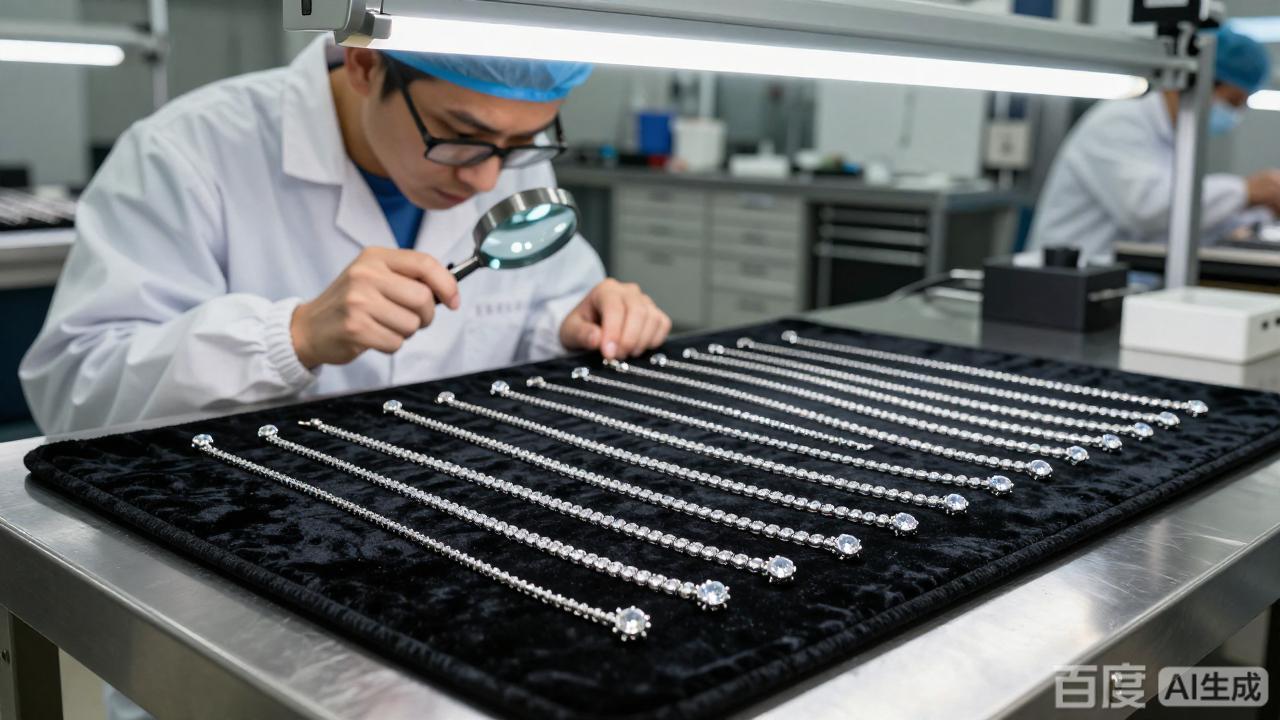
- Stone height alignment: Every stone in tennis and rivière necklaces is measured for table height with a dial indicator across the full length of the necklace. Stones outside 0.05mm tolerance are reset. This is the most time-consuming QC step but is essential for a clean, continuous line of sparkle.
- Stone color continuity: Stones are color-matched across the entire necklace length. One off-color stone in a 140-stone necklace creates a visible color break that customers notice immediately. Stones are matched to within one color grade per necklace.
- Flex test: The necklace is flexed through full range of motion (curved around a neck form, bent side to side, laid flat, and gathered) to check for stiff links, binding, or gaps between bars. Stiff sections are adjusted or re-linked.
- Lay-flat test: Necklace is draped over a curved neck form and observed from 1 meter away to confirm it lays flat without twisting, flipping, or gapping. A necklace that passes on a flat table may fail on a curved surface.
- Link pin inspection: Bar-link connecting pins are inspected under 10x magnification to confirm they are properly seated, not protruding, and secure. Loose pins are pressed or replaced.
- Clasp cycle test: Clasps are opened/closed 10 times to confirm smooth operation. Box clasp safeties must click into place. Pull-test confirms clasp holds 15lbs.
- Stone security probe: Every stone in tennis necklaces is probed individually under 10x. Pendant stones are pull-tested at 5lbs.
- Length measurement: Necklace length is measured under 50g tension (simulating how it hangs worn) and must be within ±0.25 inches of specified length.
- Weight check: Finished necklaces are weighed and compared to specification to confirm correct metal weight and stone count.
- Chain solder check (pendant/station necklaces): Chains are pulled at 8lbs tension to confirm no links open under load. Clasp attachment is pull-tested.
- Reverse side smoothness: The back of all necklace sections is checked for smooth finish. Rough edges catch on hair and clothing; exposed hinge pins scratch skin.
Our tennis necklace outgoing defect rate is under 0.9% (slightly higher than rings and earrings due to the high stone count), with pendant necklaces under 0.3%. Most defects caught in QC are single stones slightly high/low (reset before shipment) or stiff links (adjusted). Learn about full necklace QC procedures.
Production Capacity and Lead Times
Our Wuzhou factory necklace production capacity:
- Pendant necklaces (pendant + chain): 6,000-10,000 pieces/month, standard lead time 15-20 business days (silver), 20-25 days (gold)
- Tennis necklaces (3-4mm): 2,000-3,500 pieces/month, standard lead time 25-30 business days (silver), 30-35 days (gold)
- Tennis necklaces (2mm slim or 5mm+): 1,000-2,000 pieces/month, lead time 28-35 days
- Rivière and graduated necklaces: 800-1,500 pieces/month, lead time 30-40 days
- Bulk chains (without pendants): 20,000-30,000 pieces/month, lead time 10-15 business days
Tennis necklaces require more production time per piece than any other category due to the number of stones, link assembly, and intensive QC. We recommend placing Q4 tennis necklace orders by early July for holiday delivery. Rush production (25% premium) compresses tennis necklace lead time to 20-25 business days for silver, subject to capacity. Explore our OEM necklace development for custom designs.
Frequently Asked Questions
Q: What is your MOQ for moissanite necklaces?
A: 30 pieces per style for pendant necklaces (silver), 50 pieces per style for gold pendants. Tennis necklaces: 20 pieces per style for silver, 30 per style for gold (higher unit cost but lower MOQ than rings due to strong demand). Sample necklaces available at 1.5x-2x unit price. Custom necklace designs: 50-piece MOQ.
Q: Can tennis necklaces be shortened after purchase?
A: Yes, tennis necklaces can be shortened by removing one or more bar links and re-attaching the clasp. We include 1-2 spare links with every tennis necklace shipment for resizing by retailers. Tennis necklaces cannot easily be lengthened, so we offer standard lengths of 16" (choker), 18" (princess, most popular), and 20" (matinee) for stock designs, with 1-2 inch extenders optionally included.
Q: How should tennis necklaces be stored to prevent damage?
A: Tennis necklaces should be stored flat (not folded or tangled) in a soft pouch or jewelry box. Folding can stress links and kink the necklace. We provide care instructions recommending laying necklaces flat for storage, avoiding sleeping or showering while wearing, and gentle cleaning with a soft cloth. We include a care card in every package for these instructions.
Q: Can you produce necklaces with adjustable length extenders?
A: Yes. Extender chains (1 inch or 2 inch) with multiple rings allow customers to wear the necklace at different lengths. Extenders add $3-6 per unit depending on metal and length and reduce SKU complexity because one adjustable necklace covers multiple wearing preferences.
Q: Do you offer matching tennis bracelet + necklace sets?
A: Yes. Matching tennis sets use the same stone size, setting style, and finish for a coordinated look. Set orders share component production (same stone lot, same link molds) ensuring perfect color match between bracelet and necklace. We offer 10% discount when bracelet and necklace are ordered together as sets, compared to ordering separately.
Q: What if a stone falls out of a tennis necklace after purchase?
A: Our 12-month manufacturing warranty covers stone loss due to setting defects. After the warranty period, stone replacement is available as a repair service at approximately $5-15 per stone depending on stone size and location. Channel and bezel settings have very low stone loss rates (under 0.2% lifetime); prong settings have slightly higher risk (around 0.6%). We provide care guidance advising customers to avoid wearing tennis necklaces during high-impact activity.
Key Takeaways for Moissanite Necklace Manufacturers
Selecting a necklace manufacturer requires attention to engineering details that many factories overlook:
- Tennis necklaces have 120-180 stones; every stone must be set at consistent height within 0.05mm tolerance
- Stainless steel hinge pins (not brass or silver) prevent link wear and loosening over time
- Clasps must be pull-tested to 15lbs and cycle-tested 500 times; cheap clasps are the #1 failure point
- Lay-flat testing must use a curved neck form—not just a flat table—to catch twisting issues
- Place clasps 2-3 inches right of center back to reduce hair tangling and weight stress
- Tennis necklaces need 25-35 day lead times; rushing production cuts corners on stone alignment
- Bar-link construction (3-5 stones per bar) balances flexibility with durability better than cup-link for modern designs
- Include spare links with tennis necklaces for post-purchase shortening by retailers
As a specialized moissanite necklace manufacturer producing over 3,000 tennis necklaces per month alongside pendant and station necklaces, we have invested in the setting jigs, hinge pin technology, and QC inspection processes that necklace production demands. We supply brands worldwide with tennis necklaces that consistently arrive with even stone lines, smooth flex, secure clasps, and durable finish. If you are seeking a moissanite necklace manufacturer—whether for tennis necklaces, pendant programs, or custom necklace designs—we invite you to request samples and a production quote.