When a new buyer sees alloy rings quoted from thirty cents to two dollars apiece, the first question is always the same: what am I actually getting for the difference? The price gap is not arbitrary. It tracks plating thickness, stone quality, base metal grade, hand finishing and QC time. This guide breaks the wholesale market into four price tiers so you can match the ring to your customer instead of guessing.

The Budget Tier: $0.30 to $0.50
Rings in this band are the loss-leaders of the industry. The base metal is a lighter zinc blend, plating is thin (often under 0.15 microns), and stones are lower-grade cubic zirconia that lose fire within weeks. These rings sell in vending machines, at fairs, and in fast-fashion bins. They have a place: as loss leaders, as disposable festival jewelry, or as giveaway pieces. But they carry a high return rate and will not build a repeat customer base. Buy these only if your channel is price-driven and your customers expect to replace the jewelry every month.
The Workhorse Tier: $0.50 to $1.00
This is the sweet spot for most boutiques and online stores. At this price, you get a denser zinc or brass base, 0.3 microns of plating, decent CZ stones, and hand-polished finishing. A ring in this range will survive two to four months of daily wear before the plating dulls. This is the tier that builds repeat purchases: the customer notices the ring still looks good after a month, comes back for more. Most of the alloy rings in our catalogue sit in this band.
The Premium Fashion Tier: $1.00 to $2.00
Above a dollar, the differences become obvious at close range. Plating is thicker, sometimes 0.5 microns or more, with an e-coat anti-tarnish barrier. Stones are higher-clarity CZ with better cut, and the band has real weight rather than feeling tinny. These rings pass for silver or gold under normal inspection and are the pieces boutiques display on velvet rather than in bins. They carry a lower turnover but a much higher perceived value and margin. If your brand positions as "affordable luxury", this is your tier.
What Drives the Cost Up
Seven factors move a ring from fifty cents to two dollars:
- Plating thickness — double the microns, double the plating cost.
- E-coat barrier — the invisible layer that stops tarnish and skin reactions.
- Stone grade — A-grade CZ costs several times more than standard grade.
- Stone setting — pavé and micro-pavé take skilled hands and slow production.
- Base metal density — heavier brass feels substantial and resists bending.
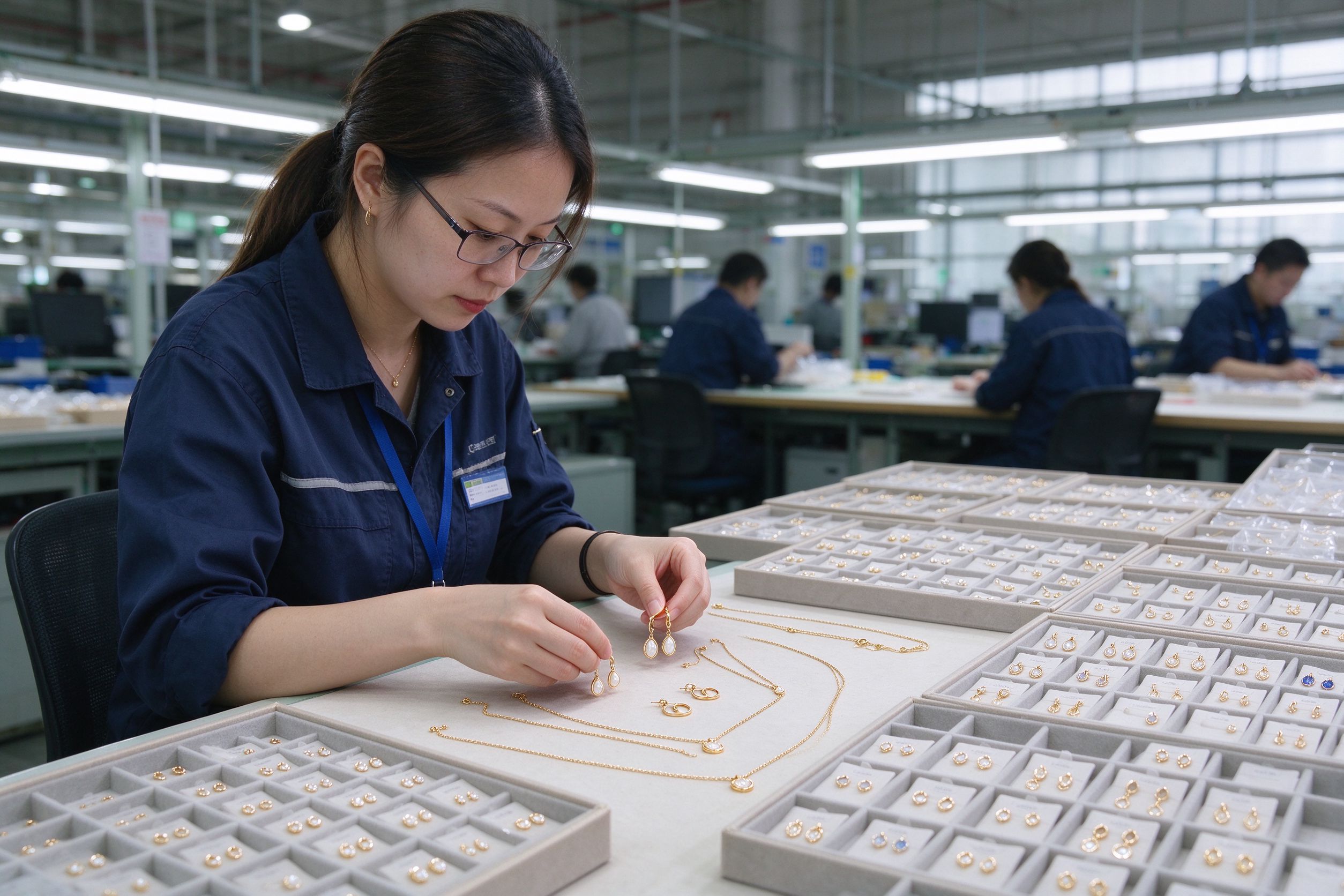
- Hand finishing — polishing every ring individually adds labor cost.
- QC pass rate — factories that inspect every piece charge more but return fewer defects.
The Cheapest Trap
The biggest mistake new buyers make is ordering only the cheapest tier because the margin looks irresistible. A $0.30 ring retailing at $2.00 sounds like a 560 percent markup. But if thirty percent of customers return it or never reorder because the ring tarnished, your real margin collapses. The cheap ring costs you more in customer trust than it saves on the invoice. A useful rule: spend at least half your first order on the workhorse tier, even if the per-unit cost stings.
Matching Price to Channel
Your sales channel should decide the tier, not your budget:
- Flea markets and kiosks — budget and workhorse tiers; impulse buys, price-sensitive.
- Boutiques and gift shops — workhorse to premium; customers expect quality.
- Amazon and Etsy — workhorse minimum; reviews punish cheap tarnish quickly.
- Bridal and proposal lines — premium tier; the moment matters, buyers pay for confidence.
We cover channel selection in more detail in our guide to bulk jewelry reselling margins.
How to Verify Quality Before You Commit
Price alone does not tell the truth because some suppliers mark up cheap goods. Order samples and run three tests. First, wipe the plated surface with a wet white cloth: if color transfers, the plating is thin and poorly cured. Second, smell the ring: sharp chemical fumes mean poor flux cleaning. Third, check the inside of the band: a rough, uneven cast signals low-grade tooling. A ring that passes all three will perform at its price tier.
Negotiating Across Tiers
Suppliers are flexible at order level, not unit level. If you mix a budget loss-leader with workhorse bestsellers, the factory can often hold the average cost down because production runs overlap. Ask for a blended quote across tiers rather than haggling on one SKU. And remember: tooling and sample fees are negotiable on larger orders, unit price usually is not.
Conclusion: Buy the Tier That Matches Your Customer
Alloy ring pricing is a signal, not a gamble. Spend thirty cents where the customer expects disposable fashion. Spend one dollar where repeat purchase matters. Spend two dollars where the ring stands for a brand. When you match the price tier to the channel, the margin looks after itself. If you would like a blended quote across the workhorse and premium tiers, browse the alloy rings range and request a custom wholesale quote.
How the Same Ring Looks at Two Prices
Imagine two plain gold band rings that photograph identically. The cheaper one costs $0.35: light zinc base, 0.15 micron plating, a thin iron post on any attached stone, and a loose clasp. The better one costs $0.85: denser brass, 0.4 micron plating, a protective e-coat, and hand polishing. After two weeks, the cheap one has dulled where the finger touches it; the better one still looks new. This is the gap customers feel but cannot explain from a photo. It is also why repeat purchases come almost entirely from the workhorse tier.
When Cheaper Is the Right Choice
None of this means cheap rings are always wrong. If your business is festival fashion, disposable trend pieces, or giveaway promotions, the budget tier is correct for your model. The mistake is using budget-tier stock in a channel that expects durability. Match the tier to the promise your store makes. A boutique that says "everyday quality" should not hang $0.35 rings next to that claim. Read how we think about affordable but good jewelry to understand the middle ground.
Negotiating Across the Price Tiers
Suppliers are flexible at order level, not unit level. If you mix budget loss-leaders with workhorse bestsellers, the factory can often hold a blended cost down because production runs overlap. Ask for a blended quote across tiers rather than haggling on one SKU. And remember that sample fees and tooling are negotiable on larger orders, while the unit price on a proven design usually is not. Browse the full alloy rings range to compare tiers side by side.