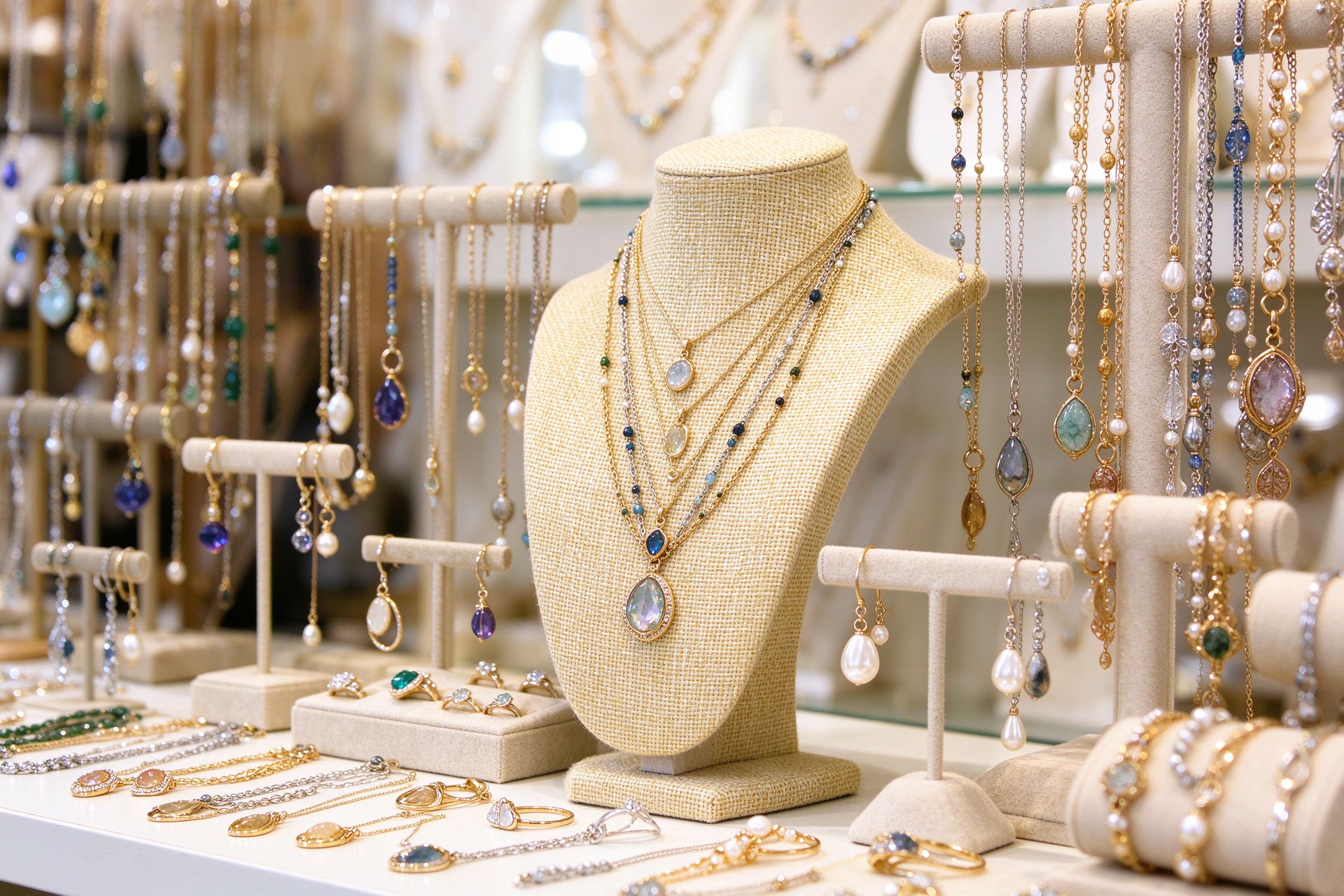
Cross-border ecommerce is one of the best ways to sell affordable alloy jewelry, because the product is light, cheap to ship, and visual. But selling jewelry online is not the same as selling it in a shop; the selection has to be chosen for how it photographs, ships and competes on a marketplace. This guide covers what jewelry to sell online, which categories work, how to price and ship them, and the compliance basics that keep your listings alive.
The online advantage is that you can test many small listings fast. The online disadvantage is that competition is global and returns are real. The buyers who win select for both photography and margin, and test before they stock deep.

The best online jewelry categories
Earrings are the single best category for online sellers: small, light, cheap to ship, and high margin. Necklaces follow, especially layered and pendant styles. Rings are trickier because of size, but simple band rings sell. Bracelets and hair accessories are strong for impulse buyers. Brooches are more niche but have loyal buyers. Start with earrings and necklaces where the fit issues are minimal.
Photography decides everything
Online, the photo is the product. A mediocre piece with great photos outsells a great piece with bad photos. Use natural light, a clean background, and show the piece worn as well as flat. Close-ups of the detail and the finish build trust. Invest in photography before you invest in more inventory. The listings with the best images win the click, and the click is the whole game online.
- Earrings and necklaces: easiest to sell online.
- Great photography beats great product.
- Show the piece worn and flat.
Pricing for a global market
Online customers compare prices instantly, so price competitively but not at the bottom. Alloy pieces allow a healthy markup, but factor in platform fees, shipping and returns. Price to leave margin after all costs, not at the factory price. Bundle multiple pieces to raise the average order value and spread shipping. A single $8 earring sale has thin margin; a $30 bundle of three pairs is profitable.
Shipping light and cheap
Jewelry is light, which is why it ships cheaply. Use standard untracked mail for low-value pieces and tracked shipping for higher-value orders. Keep packaging light but protective. Fast, cheap shipping is a competitive edge online. Because the product weighs almost nothing, your shipping cost per order can be low, and that savings either goes to margin or to a price advantage.
Compliance keeps your listings up
Marketplaces and payment providers increasingly require jewelry safety compliance. Have nickel and lead test reports ready, especially if you sell into the US and EU. A listing pulled for non-compliance is a silent loss. Request the reports from your factory before you list. This is a one-time task that protects every future listing.
Testing listings before stocking deep
The beauty of online selling is that you can list a small quantity and see what happens. Launch ten listings with a few pieces each. Watch which get clicks and orders. Reorder the winners, drop the losers. Never buy a thousand pieces of a style you have not listed. Online data beats gut feeling every time, and the cost of a wrong guess is small when you start lean.
Using reviews to improve the range
Online reviews are free market research. Read what customers love and complain about. Complaints about tarnish mean you need better plating. Complaints about fit mean size guidance needed. Reviews tell you exactly which supplier to keep and which styles to restock. A seller who reads reviews and acts on them steadily improves the range until returns fall and ratings climb.
- Have compliance reports ready before listing.
- Launch small, scale the listings that sell.
- Use reviews as free product research.
Building a brand beyond the marketplace
Marketplace traffic is rented; a brand is owned. Once you have winning styles, build your own store or social following around them. Use the marketplace data to learn what sells, then build a direct relationship with customers. Repeat orders direct are far more profitable than paying platform fees on every sale. The marketplace is a launchpad, not the final home.

Sourcing directly for online margins
Buying direct from a Wuzhou factory cuts out the middleman and lets you compete on price while keeping margin. Start with a mixed carton of your best categories, photograph them well, and list. Because factories ship fast and MOQs are flexible, you can test online trends with very little capital. That agility is the online seller's biggest advantage.
Select for clicks, margin and repeat buyers
Cross-border jewelry selling rewards the disciplined: pick light, high-margin categories, photograph them beautifully, price after all costs, ship cheaply, keep compliance on file, and test listings before you stock deep. Treat the marketplace as a learning engine, and build toward direct repeat customers. Done that way, affordable alloy jewelry becomes a genuinely scalable online business.
Platform-specific selling notes
Different marketplaces reward different product choices. Visual, trend-driven platforms favor statement earrings and layered necklaces that photograph well. General marketplaces favor safe, searchable staples like small studs and thin chains. Your own store lets you build a coordinated brand. Match the product to the platform: do not list the same photo and price everywhere. A trend piece belongs where it gets clicks; a staple belongs where it gets searched. Adapting per platform lifts conversion noticeably.
Handling returns without losing margin
Online jewelry returns happen. Keep them small by sizing clearly, showing the piece on a real person, and describing the finish honestly. For low-value earrings, it is often cheaper to refund than to pay return shipping, which protects the customer relationship. Track return reasons; if tarnish is mentioned, upgrade the plating on that style. Returns are data, not just losses, and fixing their cause over time is what lifts the rating.
Bundling to raise average order value
A single cheap earring sale has thin margin after fees and shipping. Bundles fix this. Sell a "set of three studs," a "layered necklace duo," or a "gift box of two pieces." Bundles raise the order value so shipping and fees become a smaller percentage, and they let you move more stock per sale. Customers feel they get a deal; you make the margin. This is one of the highest-return tactics in online jewelry selling.
Frequently asked ecommerce questions
What ships cheapest?
Earrings and thin chains weigh almost nothing, so they ship for very little. Bulky statement pieces cost more to send. Favor light items where possible.
How do I stand out on a crowded platform?
Better photos and a clear niche. Sell a coordinated look rather than random single pieces, and build a small direct following so you are not purely dependent on platform traffic.
Should I stock deep on a first listing?
No. List a small quantity, watch the data, and reorder only the listings that actually convert. Online testing is cheap; dead inventory is expensive.
Photography that sells affordable jewelry
Online, the photo is the product, and jewelry needs more than a flat snap. Shoot the piece on a neutral background, in natural light, and also on a model so the customer sees the scale. Add a close-up of the clasp or stone so they trust the quality. For earrings, show them worn on ears; for necklaces, show the length on a neck. When a customer can picture the piece on themselves, conversion rises. Invest in good photos before you invest in more stock; a mediocre piece with great images outsells the reverse.
Keep the look consistent across your listings so a customer recognizes your brand. A unified style of photo builds trust faster than any product description. Over time, your image style becomes recognizable in a crowded feed, which is the start of a brand rather than a generic store.
Pricing after every real cost
Online jewelry looks cheap to buy, but the selling price has to cover product, shipping, platform fees, payment fees and returns. A piece costing $2 that sells for $5 may actually lose money after all those bites. Price by the landed cost plus all fees, then bundle to lift the order value. A three-piece bundle at $25 spreads the fixed costs and becomes genuinely profitable. Never price from the factory price alone; price from the all-in cost, or the "sales" quietly lose money.
Online pricing checklist
- Include shipping, fees and expected returns in the price.
- Bundle multiple pieces to lift average order value.
- Show scale and wear in every photo.
- Test a listing small before stocking deep.
From marketplace sales to a direct following
Marketplace traffic is rented. Once a listing proves a winner, build a direct channel around it: a simple store, a social account, an email list. Repeat orders direct avoid the platform fees and build a relationship you own. Use the marketplace to learn what sells, then invite happy customers to buy directly next time. The sellers who treat the marketplace as a launchpad, not a destination, build businesses they actually control.
Shipping strategy by order value
Online jewelry shipping has two tiers. For low-value orders, standard untracked mail keeps the price competitive, and the product is cheap enough that a lost package is a small loss. For higher-value orders or bundles, tracked shipping is worth the cost to protect the customer experience. Offer both clearly at checkout so the buyer chooses. Because jewelry weighs almost nothing, even tracked shipping is affordable, and that advantage is something to advertise rather than hide.
Using reviews to refine the range
Read every review for patterns, not just complaints. If five customers call a chain "delicate," that is useful positioning; if three say it "tarnished fast," upgrade the plating. Reviews tell you which listings to push, which to improve, and which to retire. Sellers who ignore reviews keep making the same mistakes; sellers who mine them steadily lift conversion and lower returns over time.
As you learn, shift your budget toward the listings that review well. A well-reviewed staple sells on trust, and trust compounds. Over a year, the listings with five-star consistency become your sales engine, and you spend less on ads because they convert on their own. That is how an online jewelry store builds from rented platform traffic into something with real pulling power.
Online operations checklist
- Offer untracked and tracked shipping by order value.
- Mine reviews for plating and fit feedback.
- Shift ad spend toward well-reviewed listings.
- Bundle to lift the average order value.
Build the store, not just the listings
The winners online are the sellers who turn a few good listings into a recognizable brand. Pick light, high-margin pieces, photograph them beautifully, price after every cost, ship wisely, and use reviews to refine the range. Treat marketplaces as a launchpad and build a direct following where you can. Done consistently, affordable alloy jewelry becomes a genuinely scalable online business rather than a pile of one-off sales.
Bundle your three best sellers into one listing this month and watch the average order value. Small offers like this are the fastest margin lift in online jewelry.
Start with light earrings and necklaces, photograph them beautifully, price after all fees, and bundle to lift the order value. Test listings small, scale the winners, and gradually build a direct following beyond the marketplace.
Treat every listing as a test: list small, watch the data, double down on what converts, and retire what does not. Online agility is the small seller biggest advantage over big inventory players.
Done consistently, this small operation turns affordable alloy into a repeatable online business rather than a pile of one-off orders.
