Lost-wax casting is the foundational manufacturing process for nearly all production jewelry. The technique dates back over 5,000 years—used in ancient Mesopotamia, Egypt, and China to cast bronze and gold ornaments—and it remains the standard method for producing moissanite rings today because it can create complex, detailed shapes that are impossible or prohibitively expensive to machine from solid metal. While the chemistry and precision controls have improved dramatically, the fundamental principle is unchanged: a wax model of the ring is encased in a heat-resistant ceramic investment, the wax is melted out leaving a hollow cavity, and molten metal is forced into that cavity to produce an exact metal copy of the original wax.
Moissanite ring casting at HOLYCOME is performed in our Wuzhou factory on dedicated casting lines optimized for sterling silver (our primary production metal) with separate capability for 10K/14K/18K gold casting on the same equipment between batch runs. Casting quality determines whether a ring will porosity-crack, take a high polish, hold stones securely, and survive years of daily wear. Poorly cast rings may look acceptable when they leave the factory but develop cracks under setting pressure, show pinhole porosity after polishing, or bend and break far earlier than they should. This guide walks through the lost-wax casting process step by step, with specifics on equipment, tolerances, yield rates, and the quality checks that separate production-grade casting from the cheap porous silver rings that flood entry-level marketplaces.
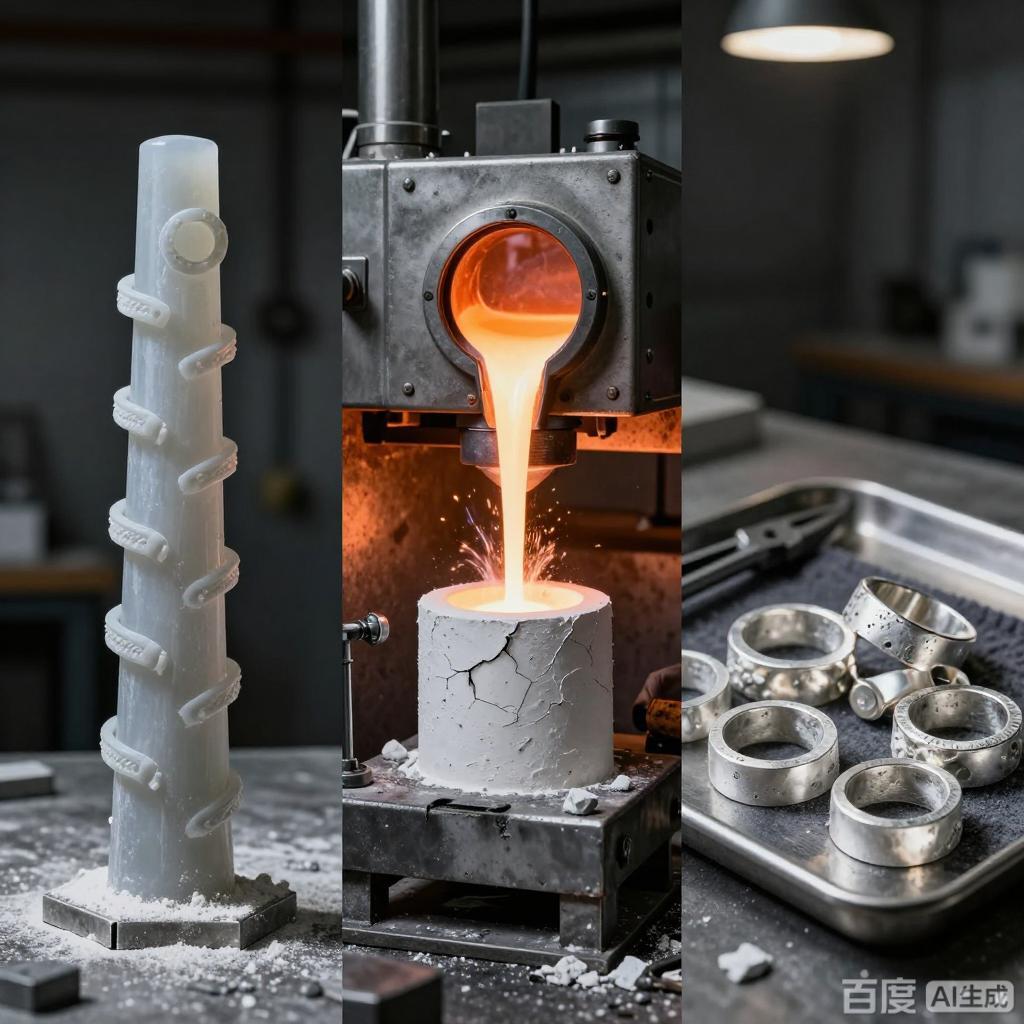
The Lost-Wax Casting Process: 12 Steps
Step 1: Wax Model Production (Wax Injection)
Casting starts with a rubber mold made from either a master silver model or a CAD-printed resin model. The rubber mold is a two-piece silicone rubber block with a cavity shaped exactly like the final ring, cut with channels (sprues) through which wax can flow. For production runs, rubber molds are created by vulcanizing raw rubber around a master model at 165°C under pressure for 45–60 minutes; once cooled, the rubber is cut open and the master removed, leaving a precise cavity.
Liquid injection wax (a blend of paraffin, beeswax, and resins formulated for jewelry casting) is injected into the rubber mold under controlled pressure and temperature:
- Wax temperature: 70–75°C (low enough to avoid air bubbles, high enough to flow into fine details)
- Injection pressure: 5–15 PSI (higher for thin filigree details, lower for bulky rings to avoid flash)
- Injection time: 5–30 seconds depending on ring size
- Clamp pressure: sufficient to hold the mold closed without crushing the wax
After cooling for 1–3 minutes, the mold is opened and the wax ring is extracted. Every injected wax is visually inspected for fill completeness (no missing details from incomplete wax flow), bubbles, flash (excess wax squeezed out between mold halves), and seam lines from the mold cut. Waxes with defects are melted and re-injected; only flawless waxes proceed to assembly.
Step 2: Wax Tree Assembly (Sprueing)
Individual wax rings are attached to a central wax rod (the sprue base) using heated wax tools, creating a "tree" that holds 12–30 rings per casting batch, depending on ring size. The attachment points (called gates) are positioned at the thickest cross-section of each ring so molten metal flows into the ring body from the thickest point (feeding shrinkage as the metal cools). Gate size is 2.5–4mm diameter, large enough to allow metal flow but small enough to be removed cleanly after casting.
Tree design is a skill: rings must be spaced evenly (10–15mm apart) so metal reaches every piece without turbulence, oriented to minimize trapped air bubbles, and positioned with their heaviest sections closest to the sprue base. Poor tree design results in incomplete fills, porosity, and casting failures—particularly for filigree rings and rings with thin gallery details.
Step 3: Weighing and Metal Calculation
The assembled wax tree is weighed and the total wax weight multiplied by the specific gravity of the casting metal to determine how much metal is needed. Sterling silver has a specific gravity of 10.4 relative to wax's ~1, so a 50-gram wax tree requires 520g of silver plus a 20–30% button reserve to ensure the flask fills completely. Overestimating metal wastes material; underestimating causes incomplete fills.
Step 4: Investment Mixing and Flask Assembly
The wax tree is placed base-down inside a metal flask cylinder (typically 3"×6" or 4"×8" depending on tree size). Investment powder—a mixture of finely ground silica (or cristobalite), plaster of Paris (calcium sulfate binder), and small amounts of graphite and other additives to control strength and porosity—is mixed with water under vacuum for 60–90 seconds to remove air bubbles, then poured into the flask to completely cover the wax tree. The filled flask is placed in a vacuum chamber again for 60–90 seconds to de-air the investment around the waxes, ensuring no air bubbles are trapped against wax surfaces (which would cause metal nodules on the casting).
Investment-to-water ratio is critical: too much water weakens the mold and causes cracking during burnout; too little water makes the investment too thick to flow over fine details. Our standard mix uses a 38:100 water-to-powder ratio for sterling silver casting.
Step 5: Investment Set
The poured flask sits for 60–90 minutes under controlled humidity while the investment sets. The plaster binder cures and the flask reaches a handling hardness sufficient to transfer to the burnout oven. Setting time must be sufficient—rushing the set causes investment cracking during the steep temperature ramp of burnout.
Step 6: Burnout (Wax Elimination)
The flask is placed inverted (base up) in a programmable burnout kiln and heated on a stepped temperature schedule to eliminate every trace of wax and moisture from the investment cavity:
- Room temp to 200°C over 2 hours (held 1 hour): slow moisture evaporation to prevent steam pressure cracking
- 200°C to 370°C over 2 hours (held 1 hour): majority of wax melts and drains from the flask
- 370°C to 730°C over 2 hours (held 2 hours): residual wax burns out completely, any carbon residue oxidized
- Cool to casting temperature (550–650°C for silver) and hold for 30+ minutes
Total burnout time is 8–10 hours depending on flask size. Incomplete burnout leaves carbon residue in the mold, which contaminates the cast metal and causes surface discoloration or brittleness. Rushing burnout is the most common cause of casting failure in low-cost factories.
Step 7: Metal Melting
Sterling silver (92.5% Ag, 7.5% Cu for hardness) is melted in a ceramic crucible using an oxy-gas torch or induction furnace, heated to 950–1000°C (silver melts at 961°C, but casting temperature is held 60–80°C above melting to ensure proper fluidity during pour). A small amount of flux (borax or commercial casting flux) is added to prevent oxidation and dissolve surface oxides on the molten metal. Degassing tablets (zinc or lithium-based) may be stirred into the melt immediately before casting to release dissolved oxygen and reduce gas porosity.
For gold casting, temperatures are higher (10K melts at ~900°C; 18K at ~920°C) and specialized fluxes are used. We cast gold in dedicated flasks separate from silver to avoid cross-contamination.
Step 8: Casting (Centrifugal or Vacuum)
Two casting methods are used in production jewelry, both designed to force molten metal into every detail of the investment cavity before the metal freezes:
- Centrifugal casting. The flask is mounted on a swinging arm on a centrifugal casting machine; the crucible of molten metal is placed against the flask opening. When released, the arm spins rapidly (300–500 RPM), creating centrifugal force that throws the molten metal into the mold cavity. Centrifugal casting provides strong force and is excellent for thin filigree and small-detailed work. Our centrifuges handle 3" and 4" flasks.
- Vacuum-assisted casting. The hot flask is placed over a vacuum chamber with a sealing gasket; the molten metal is poured into the sprue opening while vacuum is drawn from below the flask, pulling metal into the cavity with atmospheric pressure. Vacuum casting produces less turbulence (less porosity from gas entrainment) and is preferred for larger, heavier rings. We use vacuum casting for rings over 6g finished weight.
Both methods produce excellent results when done correctly; the choice depends on piece geometry and volume.
Step 9: Cool-Down
After casting, the flask sits to air-cool for 20–30 minutes (silver), allowing metal to solidify and cool below its stress-relief temperature. Quenching hot flasks in water (a shortcut some factories use to speed the process) causes thermal shock and fine micro-cracks in both the metal and the investment that can ruin the casting. Proper slow cooling is non-negotiable for quality production.
Step 10: Devesting (Investment Removal)
Once cooled, the investment is broken away from the tree, either by hand (tapping with a hammer) or by high-pressure water jet. The ring tree is then submerged in a water-and-pickling-acid solution (typically dilute sulfuric acid or a proprietary non-toxic pickling compound) that dissolves residual investment and removes surface oxidation from the cast metal, leaving a clean matte-white silver tree.
Step 11: Sprue Removal (Cutting)
Individual rings are cut from the central sprue using a jeweler's saw or thin cutoff disc, leaving a small stub of metal at each gate point. These stubs are filed or ground flat after cutting. Wasted metal from the sprue button and cut stubs is collected, refined (if done on-site) or sent back to the metal supplier for credit, and recast in future runs—silver is fully recyclable with no quality loss.
Step 12: First Inspection (Pre-Polish QC)
Every cast ring is inspected before polishing for casting defects:
- Porosity: Tiny pinholes or sponge-like voids, visible on the surface or exposed after rough filing. Caused by trapped gas or shrinkage during solidification. Porous pieces are rejected; they cannot be reliably polished or set.
- Incomplete fills: Missing sections from metal that did not flow to all parts of the mold before freezing. These are immediately obvious and always rejected.
- Flashing: Thin metal sheets that seeped into seams in the investment (usually from flask cracks during burnout). Can sometimes be filed off if not extensive.
- Cracks: Hot-tear cracks from uneven cooling, or quench cracks from improper cooling. Always rejected.
- Nodules: Small metal balls attached to the ring surface from air bubbles in the investment. Filed off if minor; rejected if attached to critical surfaces like stone seats.
Our first-pass casting yield is 93–96% depending on design complexity (simple solitaire bands cast at ~96%, intricate filigree and micro-pavé designs at ~90–93%). Defective pieces are melted and recycled.
| Stage | Time per flask batch | Temperature | Critical parameter |
|---|---|---|---|
| Wax injection | 10–30 sec/ring | 70–75°C | Pressure, temperature, bubble-free fill |
| Investment pouring | 15 minutes | Room temp (vacuum mix) | Water/powder ratio, vacuum de-air |
| Set time | 60–90 min | Room temp | Humidity, time |
| Burnout | 8–10 hours | Ramp to 730°C | Ramp rate, hold times, complete wax elimination |
| Casting | 2–3 minutes | Silver 950–1000°C; flask 550–650°C | Metal temp, flask temp, centrifugal/vacuum force |
| Cool-down | 20–30 min | Air cool | Slow cool, no quenching |
| Devesting and cleaning | 30–60 min | Room temp | Complete investment removal |
From Casting to Finished Ring: Post-Cast Production
After casting and initial QC, every ring goes through the remaining production stages (covered in detail in other articles, summarized here):
- Sprue grinding and rough filing (gate points ground flush with the ring surface)
- Pre-polish (tumbling in ceramic media for 6–12 hours to smooth surface and begin rounding edges)
- Assembly (sizing the ring to the correct finger size; soldering any separate components like prongs heads if they were cast separately)
- Setting (prongs or bezels cut and prepared, moissanite stones set by hand, prongs burnished over stone girdles)
- Final polishing (three-stage wheel polish with rouges of decreasing grit, followed by hand-buffing all contact surfaces)
- Plating (rhodium, gold, or rose gold plate if specified; nickel-free plating stack per EU REACH and FTC jewelry standards)
- Final QC (stone security, polish completeness, ring sizing, stamping, weight, and sparkle test)
Common Casting Quality Issues and Root Causes
Wholesale buyers who understand common casting defects can identify them during incoming quality inspection and avoid selling rings that will fail after customer purchase:
- Gas porosity (small round pinholes at surface): caused by overheated metal, poorly dried investment releasing steam during casting, or metal that was not properly degassed. Porous rings cannot take a perfect polish and may pit under daily wear.
- Shrinkage porosity (irregular voids near gates or thick sections): caused by insufficient metal reservoir at the sprue (button too small) or gates positioned too far from thick sections. Shrinkage causes structural weakness.
- Incomplete detail (blurry or missing fine design features): caused by insufficient casting force, metal too cool when poured, investment that was too old/weak and broke down during casting, or burnout not reaching proper temperature.
- Fire scale (dark copper oxide layer near the silver surface): caused by oxygen reacting with copper in the sterling alloy during heating, leaving a grayish stain that appears after polishing. Prevented by using fire-scale preventing compounds during casting and proper pickling post-cast.
- Rough surface finish (grainy or textured surface instead of smooth): caused by investment breakdown at high temperature, metal poured too hot, or insufficient investment drying. Rough surfaces require extra polishing that reduces ring weight and can distort details.
As a general moissanite ring manufacturing principle, if you can see porosity with the naked eye after polishing, the piece should be rejected. Micro porosity visible only under 10x magnification is acceptable on non-structural surfaces if it does not affect polish quality.
Production Capacity
HOLYCOME operates 12 centrifugal casting machines and 4 vacuum casting stations, producing 300–500 flasks per week depending on piece size and complexity. Typical production is 15,000–25,000 finished rings per month across all designs, with the capacity to scale to 40,000 during peak season (Q3/Q4 holiday and bridal season). Rush orders can be turned around in as little as 48 hours from wax to cast pieces for stock designs; standard production lead times are 7–14 days for stock design orders and 18–28 days for OEM custom design production.
FAQ
What is lost-wax casting?
Lost-wax casting (investment casting) is a jewelry manufacturing process where a wax model of a ring is encased in ceramic investment, the wax is burned out to leave a hollow cavity, and molten metal is cast into the cavity to produce a metal copy of the wax model. It has been used for thousands of years and remains the standard for jewelry production because it creates detailed shapes impossible to achieve by other methods.
What metal do you cast moissanite rings in?
Our primary production is nickel-free 925 sterling silver (with rhodium, yellow gold, rose gold, or black rhodium plating). We also cast in solid 10K, 14K, and 18K white/yellow/rose gold for premium orders.
How many rings are cast per flask?
12–30 rings per 3" flask depending on ring size and design complexity. Larger rings and statement pieces are cast fewer per flask to ensure proper metal flow.
What is the casting defect rate?
Our first-pass yield (rings that pass QC after casting, before polishing and setting) is 93–96% depending on design complexity. Defective castings are fully recycled; silver is melted and re-cast with no quality loss.
How long does the full casting process take?
Burnout is 8–10 hours (usually run overnight); metal melting and casting itself takes 2–3 minutes per flask. A flask of wax-injected trees can go from wax to devested cast tree in roughly 12 hours (mostly unattended during burnout).
Is the silver recycled?
Yes. All casting scrap (sprue buttons, gate stubs, rejected castings, polishing dust collected from dust collectors) is refined on-site or sent to a precious metal refiner for purification and reused in future casting. Silver is infinitely recyclable with no loss of quality.
Lost-wax casting looks simple from the outside—wax in, metal out—but the difference between quality casting and cheap casting is in the details: wax injection pressure and temperature control, burnout ramp rates, casting temperatures matched to metal and flask, proper sprue design, and patient cool-down. Manufacturers who cut corners on these steps produce rings that look fine out of the box but fail months later with cracked shanks, porous settings, or stones falling out. Contact our production team to arrange a factory audit or to discuss your ring casting requirements.
Independent background on moissanite — how its hardness and refractive index compare with diamond — is documented in the Wikipedia article on moissanite.
Related reading: Moissanite Ring Manufacturing: Lost-Wax Casting Flow, Moissanite Manufacturing Process: Factory QC Guide, Moissanite Ring Manufacturing: Casting, Setting & QC.