Wholesale Necklaces: Moissanite vs CZ: What to Compare

Necklaces Buyers Guide: Choosing Between Moissanite and Lab-Grown CZ for Wholesale Orders
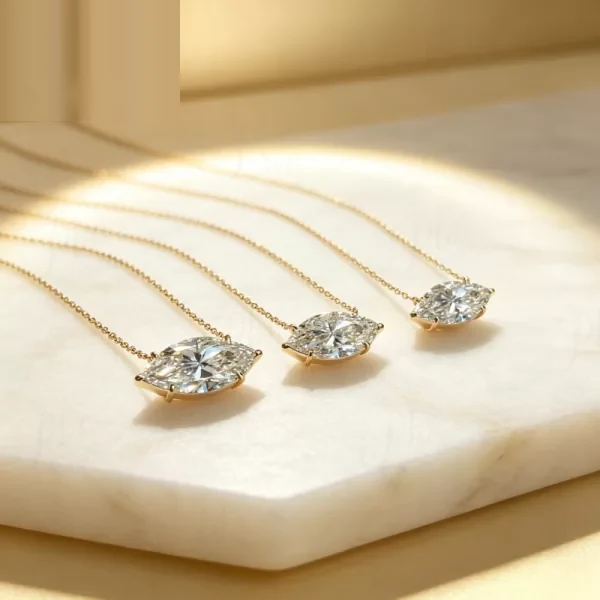
Necklaces made with moissanite outsell lab-grown CZ in most US retail settings, but the right choice depends on your price tier, your customer, and how you plan to position the product. Moissanite is a lab-created diamond alternative with a refractive index higher than diamond, so it throws more fire under store lighting and justifies a higher retail markup.
Lab-grown CZ (cubic zirconia) costs less per piece and works well for fashion-focused collections where the setting design, not the stone, drives the sale. This guide walks through the practical decisions a wholesale buyer faces when stocking both categories: stone selection, metal pairing, order quantities, lead times, quality control, and shipping to the US market.
Moissanite Versus Lab-Grown CZ: What Wholesale Buyers Should Compare
Both stones are created in a laboratory, and both should be marketed as diamond alternatives, never as natural or real diamonds. The differences that matter at the wholesale level come down to hardness, brilliance, and cost structure.
Hardness and Durability
Moissanite ranks around 9.25 on the Mohs scale, second only to diamond. That makes it suitable for necklaces worn daily, including pendant styles that sit against skin, clothing, and other jewelry. Lab-grown CZ ranks around 8 to 8.5 on the Mohs scale and will show surface wear sooner with heavy use. For a necklace collection aimed at everyday wear, moissanite holds up better; for seasonal fashion drops, CZ keeps unit costs down.
Brilliance and Fire
Moissanite has a refractive index of roughly 2.65 compared to diamond at 2.42, which produces more colorful fire under point light sources. Lab-grown CZ has a lower refractive index and tends toward a whiter, less fiery sparkle. If your retail buyers sell in person, under lighting, moissanite necklaces close sales faster. If your channel is e-commerce with lifestyle photography, the difference is less decisive and CZ can carry the line.
Cost and Pricing Structure
We price moissanite necklaces per piece or per carat depending on the item, with loose stones sold by the carat. Lab-grown CZ is quoted per piece. Because CZ costs substantially less, it suits entry price points and promotional bundles, while moissanite supports mid-tier and premium tiers where the stone itself carries a GRA or IGI grading paper.
Grading Papers: GRA and IGI Documentation for Moissanite Necklaces
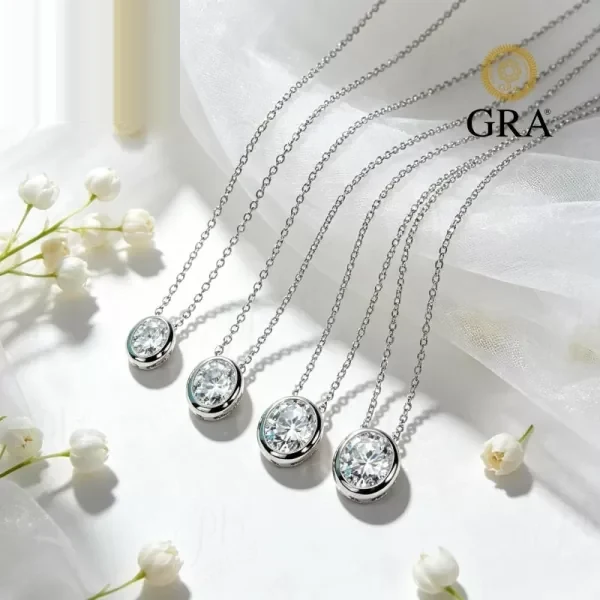
Graded moissanite stones in our necklaces come with GRA or IGI papers. These documents list carat weight, color grade, and cut details, and they give your retail customers something tangible at the point of sale. Not every style needs a graded stone. Many fashion pendants use ungraded moissanite or CZ to keep the price accessible, while solitaire and halo pendant styles benefit from documentation because the stone is the focal point of the design.
When to Specify Graded Stones
Specify GRA or IGI papers when a necklace design centers on a single stone above a threshold carat weight, when your retail partners resell to consumers who ask for documentation, or when you position the collection as a gifting line. Request ungraded stones for pavé accents, side stones, and small_cluster designs where paperwork adds cost without adding sales value.
Metal Choices for Wholesale Necklace Programs
The metal you pair with your stones shapes both the price point and the positioning. Name the true metal in every product listing and marketing asset. Each option below is accurately described, with no plated item presented as solid gold.
- 925 sterling silver: the workhorse for moissanite and CZ necklaces at accessible price points, rhodium plated to reduce tarnish
- Gold vermeil: sterling silver with a thick gold layer, a step up from standard plating for mid-tier lines
- Gold plated: a thin gold layer over a base metal, best for fashion drops and trend-driven collections
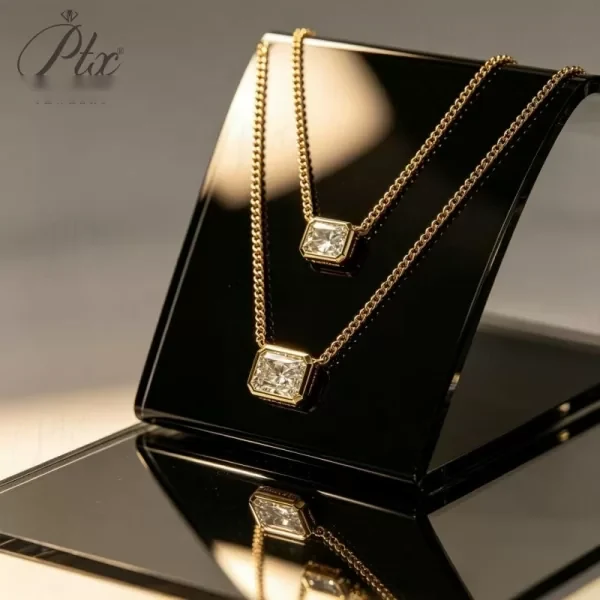
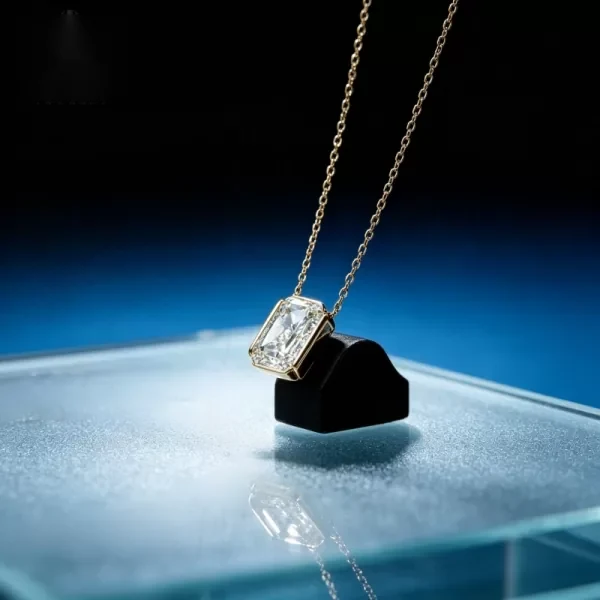
- 10K, 14K, or 18K solid gold: for fine jewelry tiers where the necklace carries a graded moissanite center stone
Matching Metal Tier to Stone Tier
A graded moissanite center stone on gold plated silver creates a positioning problem: the paperwork suggests a fine jewelry product while the metal does not support it. Pair graded stones with 925 sterling silver at minimum, and use solid gold for your top tier. Conversely, CZ on 18K solid gold is rare because the metal cost outpaces the stone value. Keep the two tiers aligned and your wholesale price list stays coherent.
Order Quantities, Sampling, and Production Timelines
Our minimum order quantity is 1 piece for stock styles and 30 pieces for custom work. This structure lets you test a moissanite pendant style with a single-unit order before committing to a production run. Loose stones are sold by the carat if you want to supply your own stones or reorder centers separately.
Sampling Process
Sampling takes 7 to 10 days. Order a sample in each stone and metal combination you are considering, since photos do not convey how moissanite fire reads under retail lighting compared to CZ. Sample orders can be paid through PayPal, which keeps the testing phase low-risk.
Bulk Production and Payment Terms
Bulk production runs 15 to 25 days after sample approval. Payment is by T/T with a 30 percent deposit and the 70 percent balance before shipment. Plan your reorder calendar around the combined sampling and production window so you do not run out of stock during peak gifting periods.
Quality Control: Three-Stage Inspection Before Shipment
Every necklace order passes a three-stage QC process: incoming inspection of materials and stones, in-process checks during setting and assembly, and a pre-ship AQL inspection on finished goods. The pre-ship AQL inspection is where stone security, clasp function, plating consistency, and matching papers get verified against your order specification.
| QC Stage | What Gets Checked |
|---|---|
| Incoming | Stone quality, metal materials, findings |
| In-process | Stone setting, assembly, plating lines |
| Pre-ship AQL | Finished necklaces, papers, packing |
Because inspections happen at three points rather than only at the end, defects get caught before they compound. A loose prong caught in-process costs far less to correct than a full pre-ship rejection, and that structure protects your lead time.
DDP Shipping to the US and Managing Your Reorder Cycle
We ship DDP to the US in 5 to 8 days after production completes, meaning duties and delivery are handled on our side and your necklaces arrive ready to sell. Combine the 15 to 25 day production window with the 5 to 8 day transit and you get a realistic lead time of roughly three to five weeks from deposit to warehouse arrival.
Building a Two-Tier Necklace Assortment
Most successful wholesale assortments carry both stone types. Use moissanite with GRA or IGI papers in solid gold and sterling silver pendant styles for your core, higher-margin line, and use lab-grown CZ in gold plated and vermeil fashion styles for trend drops and promotional pricing. This lets one factory relationship serve multiple retail tiers, with consistent QC and documentation across both.
Compliance Notes for US Retail Listings
Describe moissanite and CZ as lab-created diamond alternatives in all listings. State the actual metal, for example 925 sterling silver or 14K solid gold, and never label gold plated or vermeil pieces as solid gold. Accurate descriptions reduce returns and protect your retail partners from marketplace policy issues.
Order Terms for Wholesale Buyers
MOQ is 1 piece for stock styles and 30 pieces for custom work, and loose stones are sold by the carat. Sampling takes 7 to 10 days, and bulk production runs 15 to 25 days after the sample is approved. Pricing is quoted per piece or per carat depending on the item. Payment is T/T with a 30% deposit and the 70% balance before shipment, and PayPal is accepted for sample orders.
Frequently Asked Questions
What is the minimum order for custom moissanite necklaces?
Custom work starts at 30 pieces per style. Stock styles can be ordered at 1 piece, which makes them useful for testing demand before a custom run. Loose stones are sold by the carat for buyers who want to manage their own stone inventory.
Do moissanite necklaces come with grading papers?
Graded stones are documented with GRA or IGI papers listing carat weight, color, and cut details. You can request graded centers for solitaire and halo styles and ungraded stones for pavé and accent work. Specify your preference at the sampling stage so the production spec matches.
How long does a full order take from payment to delivery?
Sampling takes 7 to 10 days, bulk production takes 15 to 25 days after approval, and DDP delivery to the US takes 5 to 8 days. Total lead time runs roughly three to five weeks. Sample orders can be paid via PayPal; bulk orders use T/T with a 30 percent deposit and 70 percent balance before shipment.
Can I order both moissanite and CZ styles in the same shipment?
Yes. Mixed stone assortments ship together and pass through the same three-stage QC process, including the pre-ship AQL inspection. This is the most common approach for buyers building a two-tier necklace program at different price points.
Which metal should I choose for a moissanite pendant line?
925 sterling silver is the standard pairing for accessible price points, while 10K, 14K, or 18K solid gold suits premium tiers with graded center stones. Gold vermeil and gold plated options work better with CZ in fashion-led collections. Keep the metal tier and stone documentation aligned in your listings.
Start Your Necklace Program
Whether you are building a moissanite pendant line with GRA or IGI papers or a lab-grown CZ fashion collection in sterling silver and vermeil, the decisions above, stone tier, metal pairing, order quantity, and QC specification, determine how the program performs at retail. Browse our current styles and stone options on the product catalog, read more sourcing guidance on the wholesale jewelry blog, or request samples and a quote through our contact page to get your first necklace order moving.
Sources: Grading references: GIA gem education and GIA laboratory information.