Necklaces Wholesale: inbound QC
Why Incoming QC and Pre-Ship Inspection Decide Your Necklace Margin
For wholesale buyers sourcing necklaces, the two inspection points that protect your margin most are incoming quality control on raw materials and components, and the pre-ship AQL inspection on finished goods. Incoming QC catches problems before a single unit is assembled — underweight silver chain, tarnished clasps, off-color plating, or moissanite that fails grading checks. Pre-ship inspection confirms that the finished necklaces in the carton match the approved sample in weight, finish, stone setting, and clasp function.
When these two checkpoints are done correctly, defects are caught before goods leave the factory, and you avoid the far more expensive problem of receiving necklaces you cannot sell.
This article walks through how a structured three-stage QC system works for necklaces specifically, what gets checked at each stage, how to write inspection criteria into your purchase agreement, and what paperwork you should expect with each shipment. The goal is to give you a practical checklist you can use whether you are ordering one piece of a stock style or running a 30-piece custom production run.
The Three-Stage QC Structure for Wholesale Necklaces
A reliable supplier does not treat inspection as a single final event. Quality is checked in three passes, each with a different purpose. Skipping any one of them shifts risk onto you, the buyer.
Stage One: Incoming QC on Components and Stones
Necklaces are assembled from parts: chain, clasps, jump rings, pendants, and stones. Incoming QC verifies each component before it enters production. For 925 sterling silver chain, the check includes stamp verification, weight-per-meter confirmation against the spec sheet, and spot testing to confirm silver content. For solid gold necklace bodies in 10K, 14K, or 18K, incoming checks confirm karat stamping and alloy consistency across the batch.
Gold vermeil and gold plated components are checked for plating thickness and base metal correctness, because a mislabeled base metal is the most common incoming defect on plated lines.
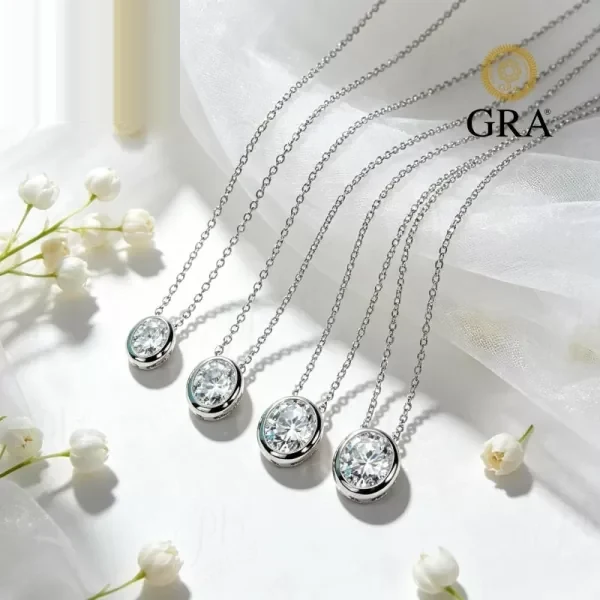
Loose stones are handled separately. Moissanite received for pendant settings is graded and documented, with GRA or IGI papers issued per stone so each finished necklace ships with its own certificate. Stones are checked for color grade, cut symmetry, and carat weight against the order sheet. Any stone that fails incoming inspection is returned before assembly, which means you never pay labor on a stone that was wrong from the start.
Stage Two: In-Process Checks During Assembly
During assembly, in-process QC catches workmanship problems early. Inspectors check solder joints on chain links, clasp attachment strength, pendant bail alignment, and stone seat security on pendants. For gold plated and vermeil necklaces, plating color is compared against the approved master sample at fixed intervals during the run, because bath chemistry drifts over long production days.
Catching a drifting plating tone at hour two of a run is a minor correction; discovering it at pre-ship inspection means re-plating the entire order.
In-process inspection also includes pull testing on clasps and connectors. A necklace that fails a pull test in-process can be re-soldered and re-tested cheaply. The same failure discovered after packing means unpacking, rework, repacking, and a delayed shipment — which matters when your bulk production window is already 15 to 25 days after sample approval.
Stage Three: Pre-Ship AQL Inspection
The pre-ship stage is a formal AQL inspection performed on packed, finished goods before the balance payment is due. Inspectors pull a statistical sample from the cartons and evaluate each unit against a defect classification list: critical, major, and minor. Critical defects — sharp edges, missing stones, broken clasps — result in automatic rejection of the affected units. Major defects such as visible plating scratches, off-center pendant settings, or chain twists are counted against the acceptance number.
Minor defects, like faint polishing marks under magnification, are logged but usually accepted within limits.
As the buyer, you can request the full AQL report before releasing the 70 percent balance under the standard T/T terms. This report should include photos of any rejected units, the sample size inspected, and the defect counts by category. If the lot fails, the supplier reworks and re-inspects before shipment.
Your payment terms give you real authority here: the balance is released only after the inspection passes, so never waive that condition on a first order with a new supplier.
What to Specify in Your Inspection Criteria
A pre-ship inspection is only as useful as the written criteria behind it. Vague instructions like "good finish" produce disputes. Concrete specifications produce measurable results. Before you approve a sample for bulk production, document the following for each necklace style:
- Metal and stamp: 925 sterling silver, 10K, 14K, or 18K solid gold, gold vermeil, or gold plated, with the exact stamp wording to appear on each piece.
- Weight tolerance: an acceptable gram range per necklace, measured on a calibrated scale at inspection.
- Chain length tolerance: for example, 18 inches plus or minus 2 millimeters, checked per unit.
- Clasp function: a defined number of open-close cycles and a pull test strength minimum.
- Stone requirements: carat weight range, color grade, and certificate type (GRA or IGI) for moissanite pendants.
- Plating spec: thickness in microns and the approved color reference for gold plated and vermeil pieces.
Attach these criteria to your purchase order and reference them in the inspection request. When the pre-ship inspector checks against a written standard rather than a memory of the sample, rejection rates become meaningful and disputes become rare.
How Inspection Timing Fits Into Your Order Schedule
Inspection checkpoints need to be planned against the production calendar, not added at the end. Below is how the checkpoints line up with a typical necklace order.
Sampling runs 7 to 10 days, bulk production runs 15 to 25 days after you approve the sample, and DDP delivery to the US takes 5 to 8 days after the goods leave the factory. The table below maps each QC checkpoint to that timeline so you know when to expect reports and when to release funds.
| Order Phase | Duration | QC Checkpoint | Buyer Action |
|---|---|---|---|
| Sampling | 7 to 10 days | Sample review and approval | Confirm spec sheet and master sample |
| Bulk production | 15 to 25 days | Incoming QC, then in-process checks | Request in-process photos mid-run |
| Pre-ship | 1 to 2 days | AQL inspection on packed goods | Review report, release 70 percent balance |
| Shipping | 5 to 8 days | Packed carton verification | Receive DDP delivery in the US |
Build one to two days of buffer for the pre-ship stage into your own launch calendar. If a lot fails AQL and needs rework, re-inspection takes time, and a buyer who has scheduled a retail drop the day after the factory's promised ship date has no room to absorb that delay. Plan the runway, and the inspection stage becomes routine instead of stressful.
Paperwork to Expect With Every Necklace Shipment
Inspection is only credible when it is documented. For each shipment of necklaces, you should receive a consistent document set, and you should make receiving it a condition of the order.
- AQL pre-ship inspection report with sample size, defect classifications, and photo evidence.
- GRA or IGI certificates for graded moissanite stones used in pendants, listed against serial numbers.
- Metal documentation confirming 925 sterling silver or the stated karat of solid gold pieces.
- Packing list with per-carton counts and per-style quantities for easy receiving checks.
Keep these documents filed by order number. If a retailer or marketplace asks you to verify metal content or stone grading on a necklace you sourced wholesale, the certificate trail answers the question in minutes. It also simplifies any claim you need to raise with the supplier, because the inspection report establishes the condition of the goods at the factory door.
Common Defects on Necklaces and How Each Stage Catches Them
Understanding which defects appear at which stage helps you ask the right questions of a prospective supplier. The most frequent necklace defects break down as follows:
- Chain weight shortfall: caught at incoming QC by weighing chain stock against the spec sheet.
- Weak clasp solder: caught in-process by pull testing samples from each assembly station.
- Plating color drift: caught in-process by comparing plated units against the master sample at set intervals.
- Loose pendant stones: caught in-process by stone seat checks, and again at pre-ship during the AQL sample pull.
- Wrong stone documentation: caught at incoming QC for loose stones and reconciled again at pre-ship against serial numbers.
- Length inconsistency: caught at pre-ship by measuring each sampled unit against the tolerance on the spec sheet.
Ask any supplier you are evaluating to describe how their three-stage QC handles each of these. A factory with a real incoming QC process can tell you what tests they run on chain stock. A factory that only describes a final visual check is telling you the defects above will reach your warehouse.
Order Terms for Wholesale Buyers
MOQ is 1 piece for stock styles and 30 pieces for custom work, and loose stones are sold by the carat. Sampling takes 7 to 10 days, and bulk production runs 15 to 25 days after the sample is approved. Pricing is quoted per piece or per carat depending on the item. Payment is T/T with a 30% deposit and the 70% balance before shipment, and PayPal is accepted for sample orders.
Frequently Asked Questions
What is the minimum order for necklaces?
Stock necklace styles have a minimum order of 1 piece, so you can test a design or fill a small gap in an order without committing to volume. Custom necklace work requires a minimum of 30 pieces. Loose stones are sold by the carat if you want to supply your own settings.
Can I inspect the necklaces before paying the balance?
Yes. Payment terms are T/T with a 30 percent deposit and the 70 percent balance due before shipment, and the pre-ship AQL inspection happens before that balance is released. Request the inspection report and photo evidence before sending the final payment.
How long does the full process take from sample to delivery?
Sampling takes 7 to 10 days, and bulk production takes 15 to 25 days after sample approval. DDP delivery to the US then takes 5 to 8 days. Add a day or two for the pre-ship inspection stage when you build your buying calendar.
Do moissanite necklaces come with certificates?
Graded stones are documented with GRA or IGI papers, issued so each finished necklace can be matched to its stone. Ask for the certificate list against serial numbers with your shipment documents. This gives you verifiable paperwork for resale and customer questions.
What happens if a pre-ship inspection fails?
Failing units are classified by defect type, and the supplier reworks the lot and re-inspects before shipment. Because the 70 percent balance is due only before shipment, you can hold payment until the re-inspection passes. This is the strongest protection a buyer has in the wholesale process.
Put a Written QC Process Behind Every Necklace Order
Wholesale necklaces carry more inspection risk than many other jewelry categories because they combine chain, clasp, setting, and stone in a single product. A supplier with incoming QC on components, in-process checks during assembly, and a formal pre-ship AQL inspection gives you three chances to catch a defect before it reaches your customers — and a documented report before your balance payment is due.
Write your tolerances into the spec sheet, request the reports at each stage, and plan your calendar around the 7 to 10 day sampling window, the 15 to 25 day production window, and the 5 to 8 day DDP shipping window.
Ready to source necklaces with a documented three-stage QC process? Browse our current styles on the wholesale necklaces product catalog, read more sourcing guidance on the jewelry wholesale blog, or request a quote and sample through our contact page.
Moissanite is a lab-created diamond alternative, not a natural diamond; listings and customer-facing copy should describe it that way.
Sources: Grading references: GIA gem education and GIA laboratory information.