Why buyers get surprised on their first rings wholesale order
I have been on the QC floor for twelve years, and the same thing happens with almost every new buyer. They get a unit price of USD 6.80 on a 925 silver moissanite band, multiply by 300 pieces, add the freight quote, and think they know their cost. Then the invoice lands with duty, certificate fees, a plating upgrade, and a shortfall on two sizes. The number they budgeted is not the number they paid.
This piece is about that gap. Not how to pick a supplier, not style trends. Just the math of a first rings wholesale order, line by line, so you can price your own retail before the container moves. I will use round numbers and a real product shape so you can follow along with a calculator.
One thing to state up front: our cost, speed and yield run roughly 20% better than typical trading companies on the same spec. The reason is boring and mechanical. We cut and set stones in the same building where the silver is cast, so there is no middleman margin, no double handling, and no week lost in transit between two workshops.
The five cost lines that make up your unit price
Every quotation you get on rings wholesale is a stack of five numbers. Ask any factory to split them and you will learn a lot about whether they own their production or just resell.
- Stone cost: moissanite graded by size, cut and color. A 1ct round brilliant in DEF/VVS is a different animal from a 5mm melee parcel.
- Metal cost: 925 silver priced by weight plus casting loss. Silver is volatile, so ask what spot price the quote is pinned to.
- Labor: setting, polishing, sizing. Hand-set pavé is the expensive part, not the casting.
- Finish: rhodium plating, 18K gold plating, or e-coat. Plating thickness and micron count change the number.
- Paperwork: GRA card per piece, IGI for larger stones, and the grading and handling fees behind them.
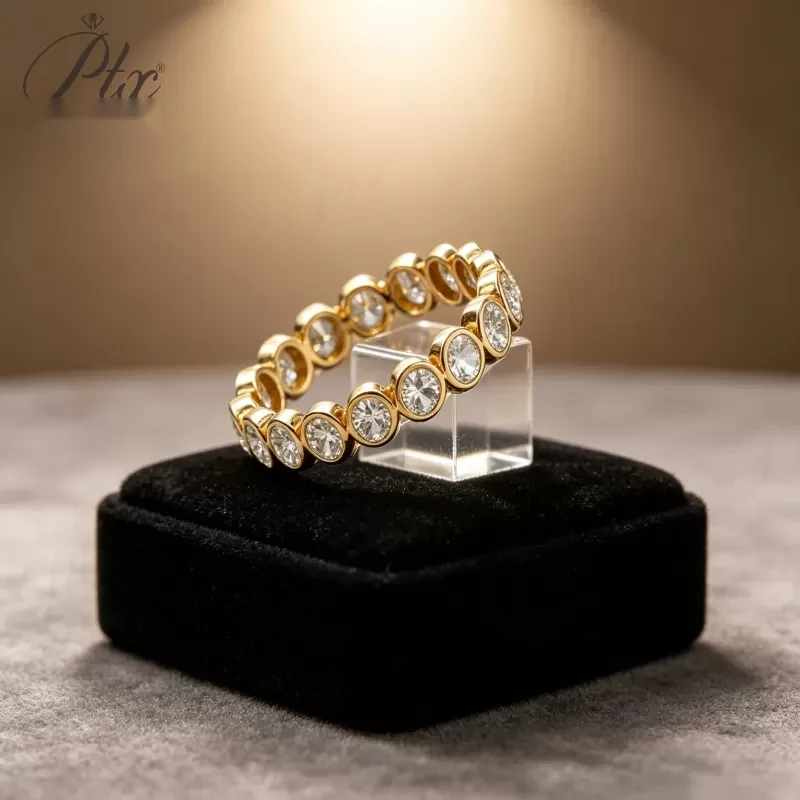
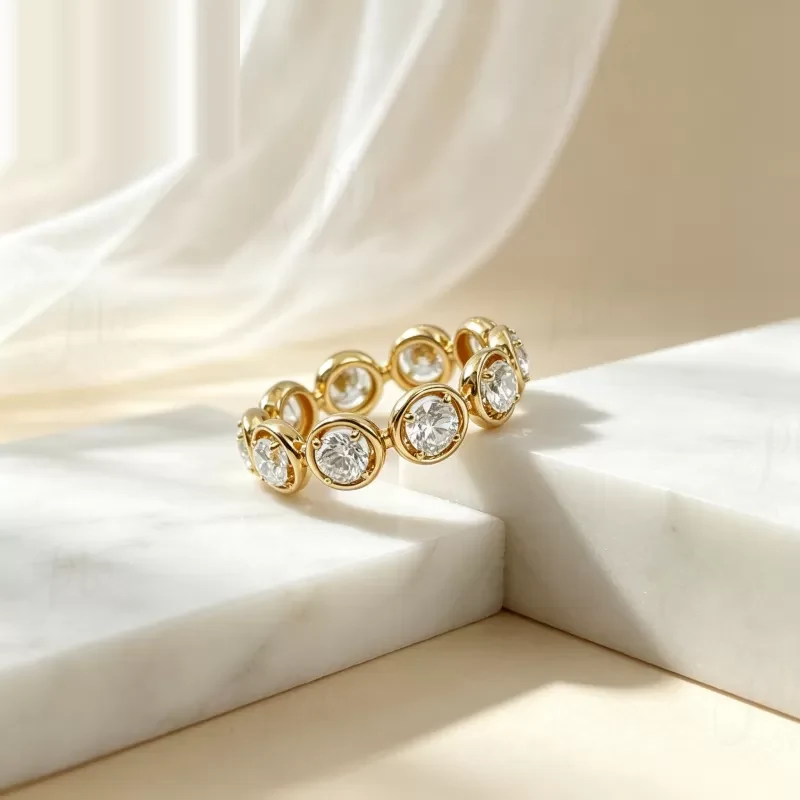
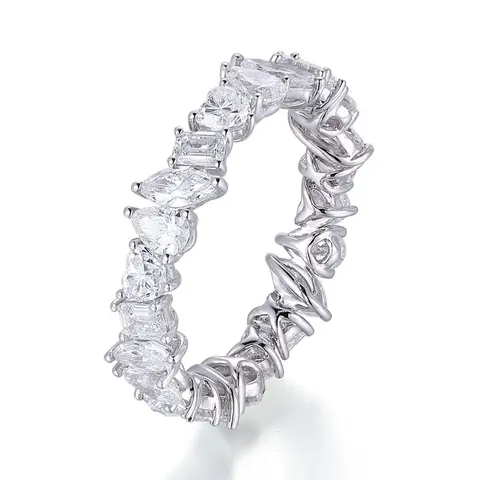
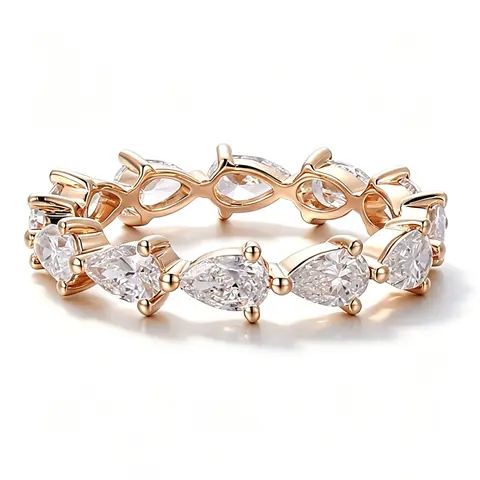
Here is a worked example on a 2.2mm plain moissanite eternity band in 925 silver, DEF color, VVS clarity, sizes 5 to 9, 200 pieces.
| Cost line | Per piece (USD) | Notes |
|---|---|---|
| Moissanite melee, 22 stones | 2.40 | Parcel price, matched cut |
| 925 silver, 2.9g | 2.05 | Pinned to spot plus 8% loss |
| Setting and polishing labor | 1.35 | Hand-set pavé |
| Rhodium plating | 0.35 | 0.1 micron |
| GRA card and pouch | 0.30 | One per piece |
| Factory unit cost | 6.45 | Before freight and duty |
That 6.45 is the number most buyers stop at. It is also the least useful number in the whole exercise, because nothing has crossed a border yet.
Freight, duty and the fees nobody quotes you
DDP delivery to a US or EU address runs 5-8 days on air express for a first order of this size. On 200 rings at roughly 2.9g each, you are shipping about 1.5kg of goods plus packaging, call it 3kg volumetric. Budget USD 60 to 120 for that leg depending on destination and carrier, which is 0.30 to 0.60 per piece. Small, but it belongs in the math.
Duty is where first-timers get stung. US tariff treatment on silver jewelry and on lab-grown or synthetic stone jewelry has shifted a lot in the last two years, and the rate depends on the declared classification, the metal, and whether stones are set. EU buyers face VAT on top. Do not take a duty rate from a forum post. Ask your broker for the current rate on the exact HS code before you sign, and ask the factory to declare honestly. A supplier who offers to under-declare is offering you a customs problem, not a discount.
If a quote looks 15% cheaper than everyone else and the freight is vague, the difference is usually sitting in undeclared value, thinner plating, or stones that did not pass incoming inspection.
There are also the quiet fees. Bank charges on a T/T, usually USD 15 to 40. A PayPal fee if you pay for samples that way, around 4%. Possibly a certificate handling charge if you want IGI on the center stones rather than GRA cards. None of these are large, but on a first order they add up to a couple of hundred dollars that was never in the spreadsheet.
Building the landed cost per sellable piece
Here is the mistake I see most often. Buyers divide total cost by pieces ordered. You should divide by pieces you can actually sell. On a first run, expect a small QC holdback. We run three-stage inspection: incoming stone check before anything is set, in-process checks at casting and setting, and a pre-ship AQL sampling pull. On a 200-piece order, a holdback of 2 to 4 pieces for rework or scrap is normal and healthy. If a factory ships 200 out of 200 with no rejects, they either have impossible yield or they are not looking.
So take 6.45 unit cost, add 0.45 freight, add duty at whatever your broker confirms, say 6% of the declared value, that is 0.39, and add a small allowance for bank and certificate fees, 0.15. Landed cost sits near 7.44 per piece. Now divide by 196 sellable pieces instead of 200. Your real cost is about 7.59.
That 7.59 is what you price against. If your retail is 39.00, your gross margin is healthy. If your plan was to retail at 19.00, you now know the order does not work before you wire a deposit, which is a much cheaper lesson than finding out after the goods arrive.
How payment terms and MOQ affect the cash math
Standard terms are 30% deposit by T/T with the balance against the pre-shipment inspection report. On a 200-piece order at 6.45, that is about USD 387 up front and the rest before dispatch. Plan the cash flow, not just the margin.
MOQ matters more than people think on a first order. We hold stock items at 1 piece minimum, so you can order a handful of styles to test. Custom designs, your own CAD, your own stone layout, run at 30 pieces per style per size run. That split is deliberate: it lets you spend small money on a market test and only commit to a custom run once a style proves itself.
Production on a custom run is 12-18 days, and that clock starts when the deposit clears and the CAD is approved, not when you first send a message. Add the 5-8 day DDP transit and a first custom order is realistically five weeks door to door. If a supplier promises ten days on a custom ring with IGI certificates, ask them which part they are skipping.
For samples, PayPal is fine and fast. For production, T/T keeps the bank fee down and gives both sides a clean paper trail. Wire only to the company account named on the invoice, never to a personal account, and confirm the details by voice on a number you already had.
Where the 20% actually comes from
Buyers hear a percentage claim and assume it is marketing. It is arithmetic. A trading company buys from a factory, adds margin, and pays for the goods to travel between the workshop and its own warehouse before it repacks and ships to you. That is two handling events, one margin layer, and typically a week of calendar time.
We cast, set, polish, plate and inspect under one roof. So there is no resale margin baked into your unit price, no re-inspection pass, and no transit week. On the same spec, that shows up as roughly 20% better on cost, speed and yield. It is not magic and it is not always 20%, but the direction is structural, not a discount.
Practical takeaway for a first rings wholesale order: ask for the five cost lines split out, confirm the duty rate yourself, budget for a small QC holdback, and price against landed cost per sellable piece. Do that once and every later order is easier.
Frequently Asked Questions
What is the minimum order for rings wholesale?
Stock styles start at 1 piece, which is useful for testing a market. Custom designs with your own CAD or stone layout run at 30 pieces per style, and production takes 12-18 days after deposit and CAD approval.
How is the price calculated on a rings wholesale quote?
Quotes are built from stone cost, silver weight at the pinned spot price, setting and polishing labor, plating, and certificate fees. Ask for those lines separately, because a single lump unit price hides which one is being trimmed.
What certificates come with the rings and what do they cost?
Every piece ships with a GRA card at roughly USD 0.30 per piece, and larger center stones can carry IGI at an added grading fee. Certificate cost is quoted per piece, not per order, so it scales with quantity.
If you want this math run on your own spec, send the style, size run and target quantity to service@holycome.com or WhatsApp +86 133 7744 7107, and we will send back a split quote with landed cost to your door plus a sample plan so you can check the quality before committing to production.