Wholesale Fashion Necklaces: Moissanite vs CZ: What to Compare

Why Moissanite Dominates Fashion Necklaces in Wholesale Buying Right Now
Fashion Necklaces built around moissanite give wholesale buyers a lab-created diamond alternative that delivers strong sparkle at a price point your retail customers can accept, making it the most practical stone choice for volume programs today. When you source from a manufacturer rather than a trading company, you control the stone selection, the metal specification, and the certification trail on every order.
This guide walks through the concrete decisions you face when choosing between moissanite and lab-grown CZ for your necklace line, and how to structure an order that protects your margin and your delivery schedule.
Moissanite vs Lab-Grown CZ: The Core Selection Decision
The first fork in the road is the stone itself. Moissanite is silicon carbide grown in a laboratory, and it refracts light differently from cubic zirconia, producing more fire and a harder surface on the Mohs scale. CZ is softer and will show surface wear sooner under daily wear, which matters if your buyers expect necklaces to hold up through regular use. Neither stone is a natural diamond, and your product copy should describe both accurately as lab-created diamond alternatives.
How the Stones Differ in Practice
- Moissanite scores around 9.25 on the Mohs scale, CZ around 8 to 8.5, so moissanite resists scratching better in pendant and chain settings.
- Moissanite has a higher refractive index, producing more dispersion and rainbow fire under store lighting.
- CZ costs less per carat and works well for trend-driven, shorter-cycle Fashion Necklaces where replacement happens within a season.
- Moissanite keeps its optical appearance over years of wear, which supports higher retail price positioning.
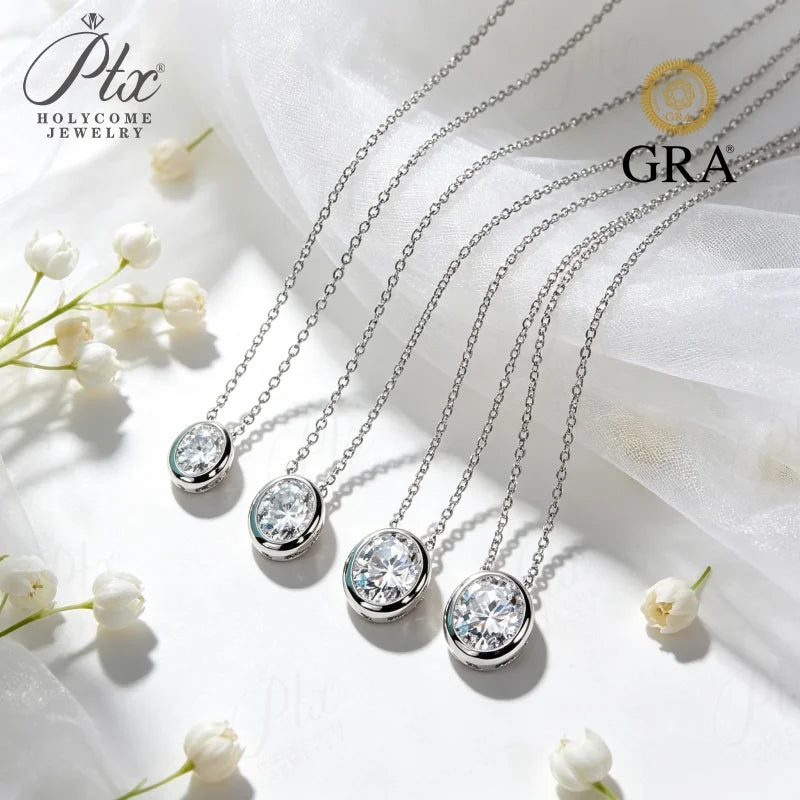
- Both stones can be graded; moissanite typically ships with GRA papers, while larger CZ selections may carry IGI documentation depending on the program.
Matching Stone Choice to Your Retail Channel
If you sell into boutiques and department store counters where the necklace carries a higher ticket, moissanite with GRA certification supports the story at the case. If you supply fast-turn e-commerce sellers running seasonal drops, CZ keeps unit cost down and lets you refresh styles frequently. Many wholesale buyers split the difference: moissanite on hero pendants and solitaire looks, CZ on pavé accents and smaller side stones within the same necklace design.
That hybrid approach controls cost while keeping the visual signature strong.
Metal Specification: Naming What You Are Actually Buying
The metal decision is where wholesale buyers most often create problems for themselves downstream. You have four real options for Fashion Necklaces: 925 sterling silver, 10K, 14K, or 18K solid gold, gold vermeil, and gold plated brass or copper. Each has a legitimate place in a line sheet, but each must be named correctly on your product pages and invoices.
Sterling Silver as the Volume Baseline
925 sterling silver is the workhorse base for moissanite Fashion Necklaces. It takes rhodium plating well, holds intricate cast detail for pavé work, and prices at a level that supports broad distribution. Verify that your supplier stamps and documents the 925 standard, because marketplace inspections increasingly check for it.
Vermeil and Plated: Know the Difference
Gold vermeil means a thick gold layer over sterling silver, which is a meaningful step up from standard gold plating over base metal. Vermeil can be described by its gold layer over silver; it cannot be called solid gold, and neither can plated product. Solid gold options in 10K, 14K, and 18K serve customers who want intrinsic metal value, and they price per piece accordingly.
Decide your metal tier before you select stones, because a moissanite set in 14K solid gold targets an entirely different buyer than the same stone in plated silver.
Pricing Structure and Order Mechanics
Wholesale pricing for Fashion Necklaces is quoted per piece for finished items and per carat for loose stones. If your program includes setting loose moissanite into custom pendant designs, expect a per-carat quote on the stones plus the piece price on the finished mounting. The order minimums are straightforward: one piece for stock styles and 30 pieces for custom work.
Loose stones are sold by the carat with no piece minimum in the same sense, so you can build a stone bank before committing to production.
The table below summarizes how the main buying decisions align with order types.
| Decision | Stock Styles | Custom Work | Loose Stones | |
|---|---|---|---|---|
| Minimum order | 1 piece | 30 pieces | By the carat | Actually, loose stones have no piece MOQ |
| Pricing basis | Per piece | Per piece | Per carat | |
| Stone options | Moissanite or CZ | Moissanite or CZ | Moissanite graded | |
| Sampling time | 7 to 10 days | 7 to 10 days | Not applicable | |
| Bulk production | 15 to 25 days | 15 to 25 days | Ready to ship |
Use this table as a planning grid: stock styles let you test a stone choice with a single piece before scaling, custom work locks in a design at 30 pieces, and loose stone purchases let you hold inventory for ongoing programs. Payment terms follow the standard structure: T/T with a 30 percent deposit and the 70 percent balance before shipment, while PayPal covers sample orders where the amounts are smaller and speed matters more than terms.
Quality Control and Certification You Can Verify
Stone selection means little without a quality system behind it. A three-stage QC process covers incoming material inspection, in-process checks during setting and assembly, and a pre-shipment AQL inspection before goods leave the factory. For moissanite necklaces, the pre-ship stage is where stone security, prong tightness, and clasp function get confirmed against the approved sample.
Reading GRA and IGI Papers
Graded moissanite arrives with GRA papers, and larger lab-grown selections may come with IGI documentation. Check that the report number on the paper matches the stone, note the carat weight and dimensions, and keep the paperwork with the shipment records so your retail customers can pass verification down the chain. For CZ, request stone specifications in writing even when formal grading is not part of the program, since cut quality varies widely between suppliers.
What Pre-Ship AQL Inspection Covers
- Stone secureness in settings across the sampled quantity.
- Plating thickness and color consistency against the golden sample.
- Chain integrity, clasp function, and jump ring closure.
- Stone count and carat accuracy against the order sheet.
- Packaging condition and label accuracy for DDP shipment.
Sampling, Production, and Delivery Timeline Planning
Plan your buying calendar around two fixed windows. Sampling takes 7 to 10 days, which is when you confirm stone choice, metal finish, chain weight, and pendant proportions on a physical piece. Bulk production runs 15 to 25 days after you approve the sample. Add DDP delivery to the US of 5 to 8 days, and a realistic door-to-door cycle lands in the range of roughly four to six weeks from sample approval to receipt at your warehouse.
Building Seasonal Programs Around the Timeline
For holiday and gifting seasons, work backward from your in-store date and leave buffer for revision rounds during sampling. If a custom moissanite pendant needs two sample iterations, you are looking at up to 20 days of sampling before production starts. Stock styles shorten the path considerably, since a single-piece trial can ship quickly and let you validate sell-through before committing to the 30-piece custom minimum or a larger stock reorder.
Order Terms for Wholesale Buyers
MOQ is 1 piece for stock styles and 30 pieces for custom work, and loose stones are sold by the carat. Sampling takes 7 to 10 days, and bulk production runs 15 to 25 days after the sample is approved. Pricing is quoted per piece or per carat depending on the item. Payment is T/T with a 30% deposit and the 70% balance before shipment, and PayPal is accepted for sample orders.
Frequently Asked Questions
Can I order one moissanite necklace as a trial before bulk production?
Yes. Stock styles carry a minimum of 1 piece, so you can order a single unit to evaluate the stone, setting quality, and chain before scaling. Custom designs require 30 pieces because of tooling and setup involved in production.
Is moissanite the same as a diamond?
No. Moissanite is a lab-created diamond alternative made of silicon carbide, with its own optical properties and hardness rating. It should be marketed as what it is, and graded stones ship with GRA papers that document the stone.
How are loose stones priced compared with finished necklaces?
Finished Fashion Necklaces are priced per piece, while loose stones are sold by the carat. If you buy loose moissanite for a setting program, the carat price applies to the stones and the piece price applies to the finished mounting and labor.
What payment methods do you accept for sample orders?
Sample orders can be paid through PayPal, which keeps small transactions fast and simple. Bulk production orders run on T/T terms with a 30 percent deposit and the 70 percent balance due before shipment.
How long does delivery to the US take?
DDP delivery to the US takes 5 to 8 days after production completes, with customs handling included. Combined with 15 to 25 days of bulk production, plan roughly four to six weeks from sample approval to warehouse receipt.
Start Sourcing Moissanite Fashion Necklaces
Selecting between moissanite and lab-grown CZ comes down to matching stone performance, metal tier, and certification to your retail channel, then structuring the order around stock trials, the 30-piece custom minimum, and a realistic six-week timeline. Review current designs and loose stone options on our product catalog, read more sourcing guidance on stones, metals, and order terms in our wholesale jewelry blog, and request samples or a custom quote through our contact page to get your first necklace program moving.
Sources: Grading references: GIA gem education and GIA laboratory information.