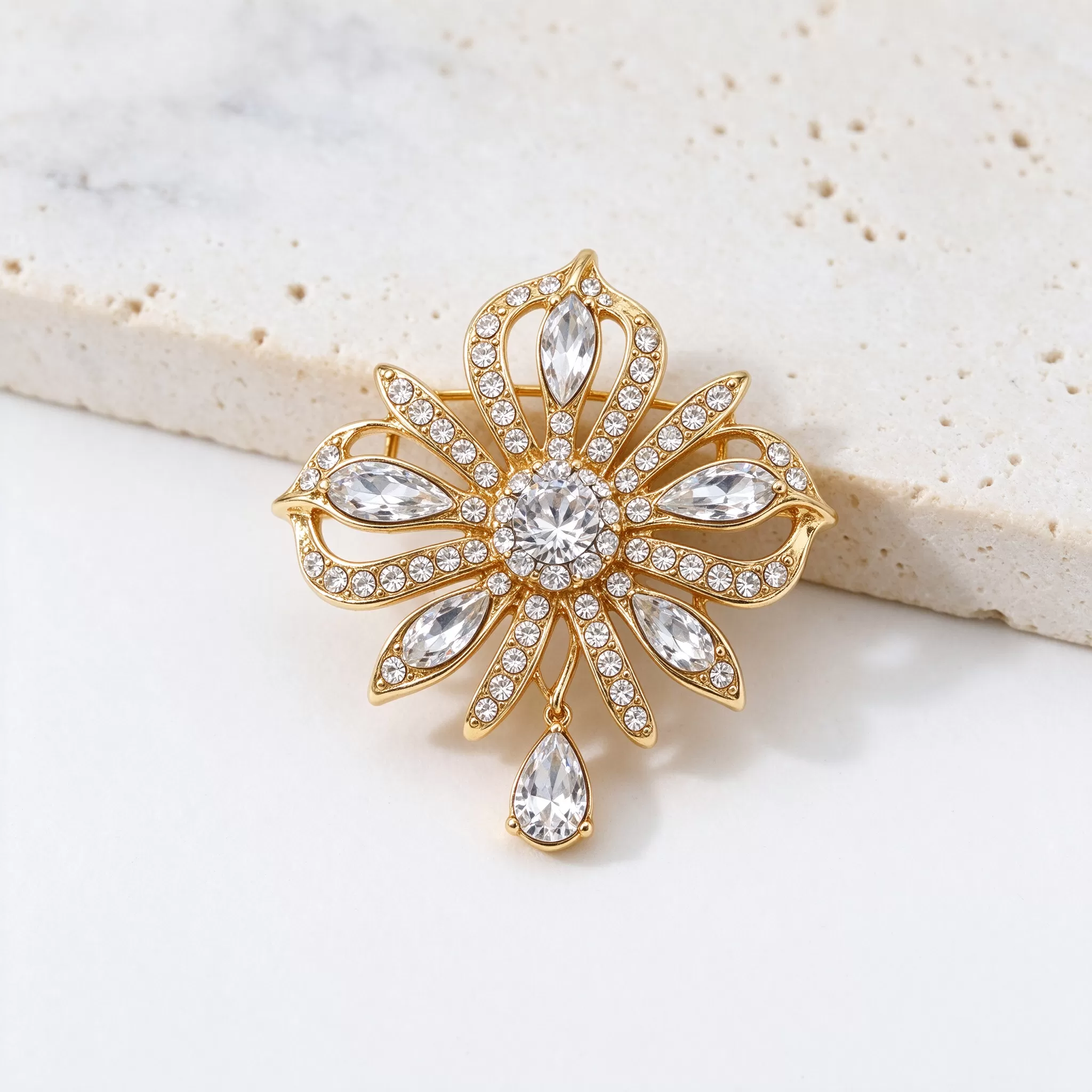
Brooches are the quiet growth category that most fashion jewelry buyers keep forgetting to order. Walk into any boutique, department-store accessory counter or wedding-fair pop-up and the earring wall is packed, the necklace rail is full, and the brooch tray in the corner is almost empty. That gap is the opportunity. A well-chosen brooch line carries one of the best unit margins in the whole accessory department, requires almost no sizing work, and travels cheaply because pieces are small and dense. This guide is written for boutique owners, Amazon and Etsy sellers, wedding planners and wholesale distributors who want to buy alloy brooches and pins factory-direct from Wuzhou without overpaying or getting burned on quality.
If you have bought earrings or necklaces before, brooches feel familiar but they have their own logic. The finding, the weight, the display and the customer expectation are all slightly different. The buyers who treat brooches as a real category rather than a clearance-bin afterthought tend to find that this small tray outperforms several larger categories on margin per square foot. The rest of this guide walks through exactly how that works.

Why brooches deserve space in your 2026 buy plan
Several things are happening at once in the brooch market. Tailoring is back. Sales of blazers, waistcoats and structured coats have climbed for two straight seasons, and a tailored garment without a pin on the lapel looks unfinished to a growing share of customers. At the same time, younger buyers have rediscovered brooches as a way to personalize denim jackets, tote bags, shirt collars and knitwear. A pin no longer signals an older customer; on TikTok and Pinterest it reads as a styling detail, the same way layered chains did three years ago.
From a buying perspective the category is attractive for three concrete reasons. First, average wholesale price is low and retail markup is high. A plated alloy brooch that costs you under two dollars ex-factory can retail for twelve to twenty dollars because customers shop the look, not the gram weight. Second, brooches do not need size ranges, half-sizes or try-on rooms. You buy one piece per style and it fits every customer. Third, they pack and ship efficiently. A thousand brooches occupy a fraction of the volume of a thousand necklaces, which keeps your landed cost and your storage footprint small.
There is a fourth, less obvious advantage: returns. Jewelry returns usually come from sizing mistakes, clasp issues and allergy reactions. A brooch has no size, a simple clutch that is easy to replace, and a small contact area against skin. In practice, brooch return rates sit well below earring and necklace return rates, which protects both your margin and your review score on marketplaces.
- Low return rate: no sizing, no clasp-length guesswork.
- Strong gift appeal: small boxed pins sell well in November and December.
- Visual merchandising flexibility: pin onto velvet busts, cards or display trays.
- Reorders are fast because a winning style rarely goes out of fashion in one season.
- Dense packing keeps shipping and warehousing costs low.
Alloy brooch construction: what you are actually buying
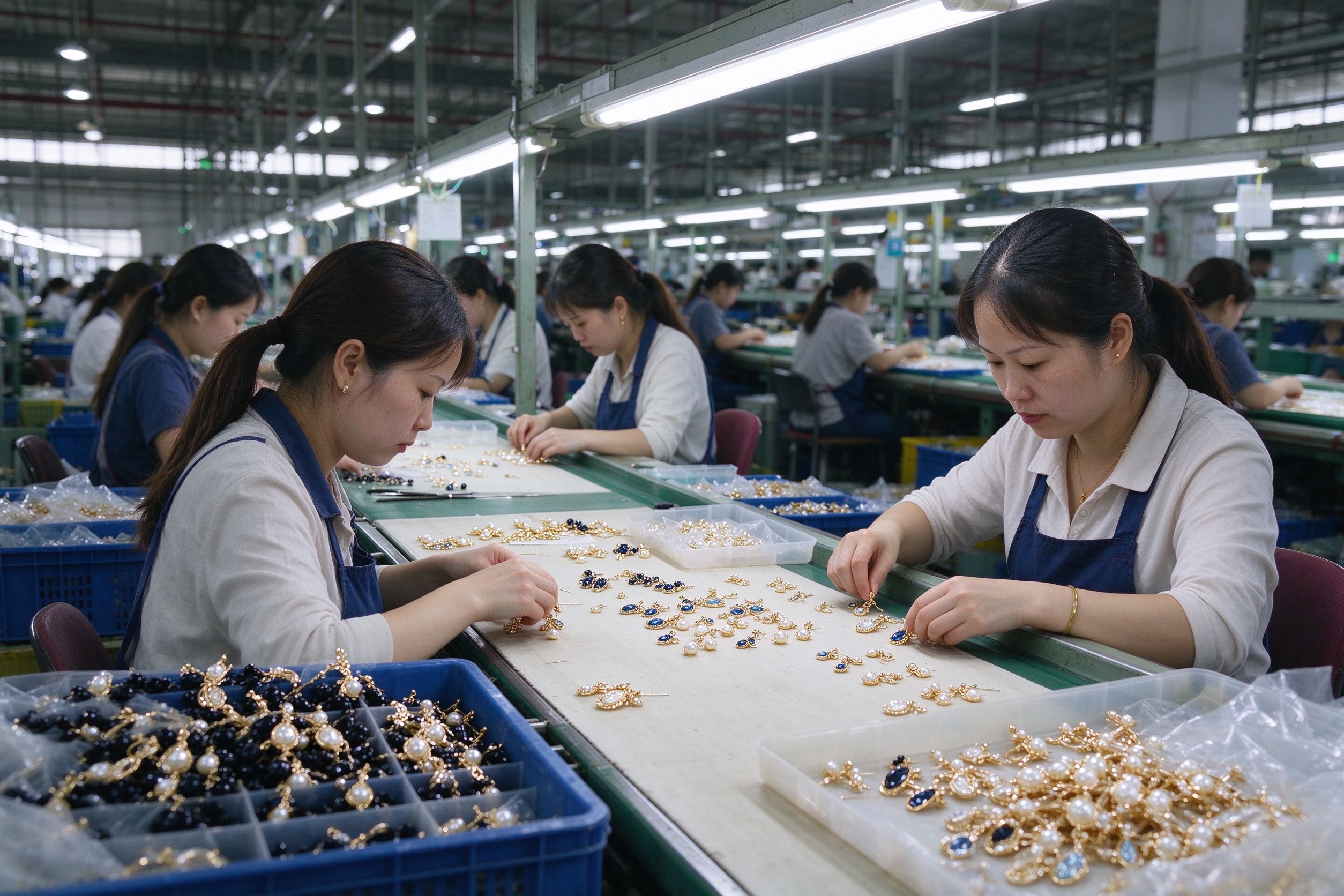
Most wholesale brooches sold out of Guangxi and Guangdong factories are zinc-alloy or tin-alloy castings, then copper-plated or brass-plated, then finished with gold, rhodium, antique-silver or black plating. Understanding the build lets you ask the right questions on a sample order and reject a supplier who cannot explain it. When a factory cannot tell you the base material, the plating thickness or the nickel status, that is usually a trading company reselling someone else's stock, not a manufacturer controlling the process.
Pin backs and fasteners
The single most common brooch complaint from end customers is a clutch that slides off or a pin that bends. When you compare suppliers, ask specifically about the back finding. A decent butterfly clutch or a safety catch should hold firmly but still open with a pinch. Avoid cheap roll-over clasps that catch on fabric. The pin stem itself should be straight, hardened and welded securely to the back of the casting. On sample orders, open and close each piece fifty times before approving bulk; if the back feels loose after a few openings, reject it. A loose clutch is not a minor flaw, it is the reason a customer leaves a one-star review.
Plating and stone setting
The face of the brooch is where the value is. Look for smooth enamel fills, tight stone settings with no loose cubic zirconia, and even plating with no black spots at the crevices. Ask the factory whether they use nickel-free plating and whether the final layer is e-coat or lacquer, which is what keeps the gold from tarnishing within a few months. For the US and EU markets, also request the nickel-release and lead test report so you are not blindsided by a recall notice after the goods land. Plating thickness is measured in microinches; ask for at least 0.3 micron of gold flash over nickel, or a thick e-coat on nickel-free ranges.
The best-selling brooch styles to stock in 2026
Not every brooch sells equally. Based on our own factory order data and what repeat buyers reorder, the following categories consistently move faster than the rest. Use them as your core range, then experiment with one or two trend styles per season. Over-ordering novelty pieces that will be stale by March is the most common mistake new buyers make.
Floral and botanical pins
Flowers, leaves, cherry blossoms and roses are the perennial backbone. They work on lapels, scarves, handbags and lapel cards, and they skew slightly feminine but not overly so. Enamel petals with a center stone are the safest reorder. Keep three or four colorways per shape so a buyer can pick a tone that matches her coat. Floral pins sell year-round but spike in spring and again in the run-up to Mother's Day.
Animal and insect brooches
Butterflies, dragonflies, ladybirds, swallows and cats are reliable impulse buys. They photograph beautifully and do well on social media. The risk is that overly cartoonish animals look cheap; choose pieces with clean enamel lines and a restrained amount of sparkle. Animal pins cluster well on a denim jacket, so they are the natural add-on to your hero floral range.
Enamel statement pins
Geometric enamel bars, letter pins, and small slogan brooches appeal to the Y2K and minimalist customer. These are the pieces that sell to a younger demographic buying for denim and canvas jackets rather than wool coats. They are also the easiest pieces to private label, because a flat enamel surface takes a printed or foil-stamped backing card cleanly.
Silk scarf rings and kerchief slides
Technically a different finding, but buyers group them with brooches. A scarf ring or slide lets a customer secure a silk square at the neck, and it pairs naturally with a brooch display. It is one of the easiest add-on sales you can put on a counter. Cross-sell them next to florals and bar pins to lift average order value.
Pricing tiers and MOQ strategy
Factory pricing for alloy brooches usually breaks into three tiers. At the entry tier, plain cast and plated pins without stones run from roughly $0.35 to $0.80 per piece at 500 to 1,000 pieces per style. Mid-tier enamel and CZ-set pieces run $0.90 to $1.80. Premium pieces with multiple stones, hand-painted enamel or 18k gold flash run $2.00 to $4.00. As a reseller, plan your retail price at roughly five to eight times your landed cost for entry and mid-tier pieces, and four to six times for premium pieces.
MOQs are negotiable. Most factories will start a new buyer at 100 to 200 pieces per style across a mixed carton, which is enough to test four to six styles in one order. Do not commit to 1,000 pieces of a single shape on a first order. Use the first order to test sell-through, then reorder the winners at volume where the unit price drops. A common pattern among successful resellers is a 200-piece test order, a 1,000-piece reorder of the top two styles, and then standing monthly reorders once a style proves it has legs.
- First order: 100-200 pieces per style, mixed carton, 5-8 styles.
- Reorder: 500-1,000 pieces of the two or three winners.
- Private label: add 1,000 pieces per style for custom backing cards.
- Negotiate plating upgrades free at 2,000 pieces rather than paying per-piece surcharges.
- Ask for price breaks at 500, 1,000 and 3,000 pieces before you commit.
Your QC checklist before a bulk shipment
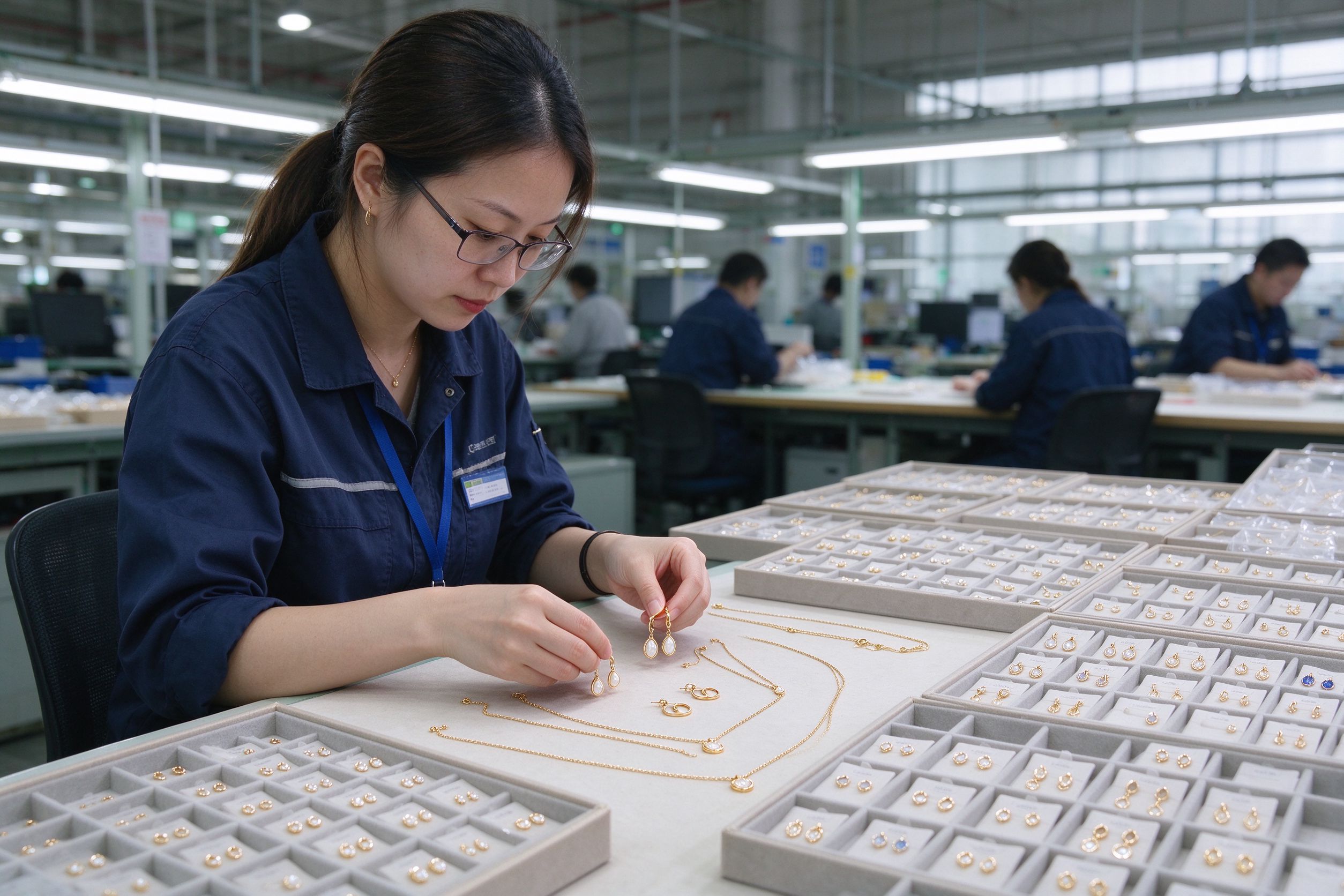
Brooches are small, so defects are easy to miss in a bulk carton. Before the factory ships, ask for a pre-shipment photo report and run this checklist on the samples you receive. For larger orders, a third-party inspection in Wuzhou before the container closes costs very little relative to the value of a rejected shipment.
- Pin stems are straight and welded; clutch opens and closes firmly after 50 cycles.
- Plating is even, no black spots, no flaking at high-wear edges.
- Enamel is level with no bubbles, cracks or overflow onto the metal.
- Stones are set tight; shake the piece and listen for rattling.
- Back finding does not scratch fabric; run it lightly across cotton.
- Nickel and lead test report is on file for the batch.
- Weight feels consistent; a suddenly light piece means a thin casting.
Logistics, packaging and landed cost
Because brooches are small and dense, they are one of the cheapest jewelry categories to ship. A carton of 1,000 brooches weighs only a few kilos but holds a high retail value, so they travel well by express courier rather than sea freight. That short lead time is a real advantage: you can reorder a winner in two to three weeks without tying up cash in a month-long ocean shipment. For air freight, keep the commercial invoice value realistic; declaring every brooch at its retail value will draw customs attention, and under-declaring too aggressively creates its own problems. Use a reasonable wholesale unit value on the invoice.
Packaging matters even for loose pins. Ask the factory to wrap pieces individually in poly bags or tissue so plated surfaces do not rub against each other in the carton. Brooches shipped loose in a box will scratch each other, and a scratched gold finish looks used before a customer ever touches it.
Merchandising tips that lift brooch sell-through
A brooch hidden in a drawer does not sell. Display matters more for this category than for almost any other. Pin pieces onto velvet busts, linen-covered boards or a styled blazer lapel so customers can see the scale. Group them by color family rather than by shape, because customers shop by outfit color. Price them in a tight ladder, for example $12, $16 and $22, so the middle tier feels like the obvious choice. Train your staff to pin one on a customer's coat during checkout; that single gesture converts more brooches than any shelf talker.
Online, the same logic applies. List each brooch on a real garment, not a cutout on white. State the size in centimeters so the customer judges scale against her own lapel. Suggest two ways to wear it, and pair each pin with a scarf ring or a pair of earrings in the same tone. Cross-sell lifts average order value without pushing extra inventory.
Start your brooch line the smart way
Brooches are not a fashion risk; they are a margin opportunity waiting for a buyer who treats them as a real category rather than a clearance bin. Order a mixed sample carton, test four to six styles across floral, animal, enamel and scarf-ring shapes, measure which ones customers actually pick up, and then reorder the winners at factory volume. Wuzhou factories can turn a repeat brooch order in two to three weeks, which means you can keep your cash moving and your display fresh. If you are building a 2026 buy plan, put brooches on the list this season. Start small, test hard, and reorder the pieces that customers actually photograph.
