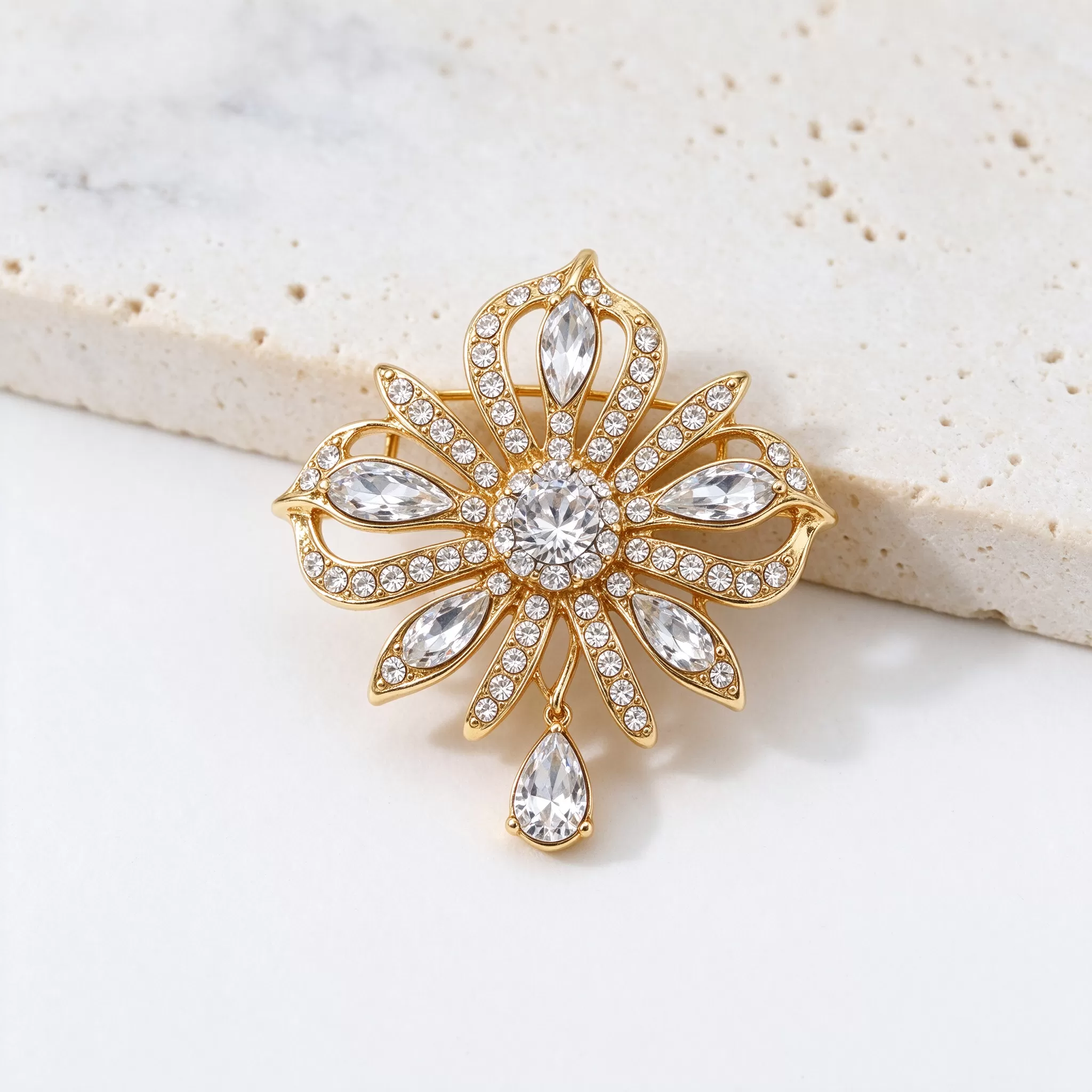
The vintage aesthetic is no longer a niche. Antique-look brooches, Edwardian floral pins, Art Deco geometric bars and Victorian-style ornate settings now sit alongside Y2K pieces in the same display tray. For resellers, vintage-style brooches are attractive because customers pay a premium for the look of age, even when the piece is a brand-new alloy casting finished to mimic it. This guide explains how to buy vintage-inspired brooches wholesale, which period styles actually sell, how to ask factories for the right finishes, and how to price them for resale.
Before you start, separate two ideas. Genuine antique brooches are a different market altogether, usually traded through collectors and auction houses, with authentication and fragile condition. The wholesale business is in newly made pieces that borrow the visual language of the past. That distinction matters for your listings: describe them as vintage-inspired, antique-look or retro-style, never as real antiques. Done honestly, the customer still loves the look and you avoid return and trust problems.

Vintage-style means new metal with an old finish
Be clear on terminology. Almost everything sold as "vintage brooch wholesale" out of a Chinese factory is newly made alloy with an antique finish, not a second-hand or estate piece. That is actually good news for your margin. You get the visual language of a bygone era at a fraction of the cost of real antiques, and you can stock it in volume. The skill is in specifying the finish and the motif accurately so the piece reads as intentional rather than cheap.
The four finishes that factories control well are antique gold (a warm dull gold with darkening in the crevices), antique silver (a brushed pewter tone with oxidation), antiqued brass (a brown-gold patina), and gunmetal or black ruthenium. When you send a sample request, attach a reference photo of the finish you want, because "vintage" means different things to different people. A factory in Wuzhou may picture 1970s Americana while you picture 1920s Paris; a reference photo removes that ambiguity.
The period motifs that resell best
Not every historical era translates. Based on what resellers reorder, the following motifs move consistently. Build your first range around these rather than chasing obscure historical references that customers will not recognize.
Art Deco geometry
Fan shapes, sunbursts, stepped rectangles and clean linear forms with enamel inlay. Art Deco pieces photograph beautifully against modern tailoring and appeal to both a mature customer and a younger retro fan. Rhodium or antique silver finishes dominate here. Art Deco is the safest entry point because the geometric vocabulary is instantly recognizable and does not look costume-y even on a low budget.
Edwardian and Victorian florals
Delicate roses, lily-of-the-valley, ribbons and bow motifs in soft enamel. These skew romantic and sell well through wedding and mother's-day gifting. Gold or antique gold plating works best. Edwardian pieces have a light, airy feel; Victorian pieces are heavier and more ornate. Stock a few of each so a customer can choose between delicate and dramatic.
Mid-century figural pieces
Stylized birds, butterflies and scrollwork from the 1950s and 1960s vocabulary. These are the conversation pieces that buyers post about. Keep the enamel colors soft rather than saturated to keep the vintage read. Mid-century pieces overlap with the cottage-core and grandmillennial trends, which have a long runway.
Naturalistic and nature revival
Leaves, acorns, snakes and beetles in antiqued metal. This category overlaps with the gothic and cottage-core customer and has a long tail of steady demand. Nature revival pieces also work well in autumn and winter merchandising.
- Art Deco: geometric, enamel bars, fans, sunbursts.
- Edwardian/Victorian: florals, bows, romantic soft enamel.
- Mid-century: stylized birds, butterflies, scrollwork.
- Nature revival: leaves, snakes, beetles, antiqued finishes.
How to specify an antique finish to a factory
The difference between a convincing vintage pin and a cheap costume piece is almost entirely in the finish. When you brief the factory, ask for these specifics rather than writing "make it vintage." Vague instructions produce inconsistent batches, because each artisan interprets "old" differently.
- Darkening (oxidation or blackening) in recessed crevices only, not on raised surfaces.
- A slightly brushed or matte top layer rather than a high-polish mirror shine.
- Soft enamel colors with a subtle fade, not neon or heavily saturated tones.
- Slightly aged, rounded edges that look handled rather than freshly die-stamped.
- Nickel-free plating even on antique finishes, for sensitive skin and compliance.
Request a finish sample card before you approve bulk. Plating batches drift, and a finish that looked right on the first sample can come out too shiny or too black on the production run. Keep one approved physical sample in your office so every reorder can be matched against it. This one discipline eliminates most finish complaints.
Avoid chasing the year's "it" color in vintage pieces. The whole point of a retro range is that it does not date. A piece colored in a trend magenta may look striking for one season and look embarrassingly dated the next. Stick to muted, time-tested tones: burgundy, forest green, navy, cream, soft blush. These sell for years and reorder reliably, whereas a neon retro piece ties up cash for a single quarter. The longevity of the palette is part of the product.
Pricing vintage-style brooches for resale
Vintage-inspired pieces carry a higher perceived value than plain modern pins, and your pricing should reflect that. A convincing antique-finish alloy brooch that costs you $1.20 to $2.50 ex-factory can retail at $24 to $45 because the customer is buying the aesthetic, not the metal weight. Frame the listing as "antique-look," "vintage-inspired" or "retro-style" rather than claiming it is genuinely old, which would be a compliance and trust problem.
Tier your range. Offer one entry piece around $14 retail for impulse buyers, a mid tier around $28 for gifting, and one hero piece around $45 for the collector. The gap between tiers lets the customer anchor on the hero and see the mid tier as reasonable. Resist the temptation to discount the vintage range; these pieces sell on atmosphere, and a sale sticker undermines the illusion you are selling.
Because the perceived value is high, vintage-style pieces also tolerate a small box or pouch better than plain modern pins. Adding a velvet pouch for $0.30 lifts the retail price by $8 to $10 and transforms the piece into a gift. Do this on the mid and hero tiers rather than the entry piece, because the entry buyer is price-sensitive while the gift buyer is not. Segmenting by packaging is one of the simplest ways to serve two customers with the same underlying brooch.
Sourcing channels and MOQ reality
For vintage-style brooches, factory-direct from Wuzhou and the wider Guangxi alloy cluster is usually the best route because the tooling already exists. Most factories hold molds for hundreds of vintage-style shapes, which means you can buy existing designs at low MOQ rather than funding new tooling. Typical MOQ for an existing mold is 100 to 200 pieces per style, which is perfect for testing a new retro range.
If you want a truly exclusive design, custom tooling runs from $150 to $500 per mold depending on complexity, with a higher MOQ of 500 to 1,000 pieces per style. Reserve custom tooling for a style you have already validated as a winner, not for a first experiment. A common mistake is commissioning an exclusive design on a gut feeling; the cash tied up in a dead custom mold is the most expensive error a new buyer makes.
- Existing molds: MOQ 100-200, lowest risk for testing.
- Custom tooling: $150-500 per mold, MOQ 500-1,000.
- Match every reorder to a physical approved sample.
- Keep both antique gold and antique silver finishes per shape.
QC watch-outs specific to vintage pieces
Antique finishes hide defects differently than bright plating. Run these extra checks on samples, because the dark crevices that signal "old" can also mask sloppy casting if you are not looking closely.
- Oxidation is even and intentional, not splotchy black spots.
- Enamel fills are clean; antique finishes make small enamel spills more visible.
- Back finding matches the front finish so the pin does not look mismatched when it opens.
- Plating does not chip on high-contact edges after 24 hours of gentle handling.
- Pieces do not smell of casting flux, which indicates poor cleaning.
- Stones, if any, are set flush rather than perched on a shiny new-looking bezel.
Marketing vintage brooches the right way
Vintage-style jewelry sells on story and styling. Product photos should show the piece on a worn blazer, a silk scarf or a knit cardigan, not on a sterile white background. Use words like "inspired by," "antique-look" and "retro-style" rather than "antique" or "estate," which implies genuine age. Target the customer who already buys tweed, pearls and second-hand tailoring; they are your most likely repeat buyer.
Pair each brooch with a short styling note in the listing: "Wear on the lapel of a wool overcoat, or cluster two small florals on a denim jacket." That single sentence reduces returns and increases add-on purchases because the customer can imagine the piece in her own wardrobe. On social media, show the brooch alongside books, teacups and old mirrors rather than flat-lays of neon; the mood sells the piece.
Because the pieces are new but look old, be honest in your copy and you will build trust. Customers who buy an "antique" and receive a brand-new piece feel cheated; customers who buy a "vintage-inspired" piece and receive a convincing, well-made brooch feel delighted. The whole category works on expectation management. Set the expectation correctly and the product does the rest.
Photographing vintage brooches so they sell
The mood of a vintage pin is half the sale, and product photos either deliver that mood or kill it. Hard, direct studio light flattens antique finishes and makes a convincing piece look like cheap costume jewelry. Instead, shoot near a window with soft daylight, and let a little shadow fall in the crevices so the oxidation reads as depth rather than dirt. Props should reinforce the era without competing: a brass mirror edge, a silk handkerchief, a leather-bound book, a cup and saucer. The background should be muted linen, wood or wool, never white acrylic.
Show scale by photographing the pin next to a coin or held between two fingers, because customers otherwise cannot judge whether a "statement" brooch is five centimeters or twelve. Shoot one close-up of the enamel and one shot of the piece worn on a real lapel. The close-up justifies the price; the worn shot sells the fantasy. Resellers who skip the worn shot consistently under-convert, because the customer cannot imagine the piece in her own wardrobe.
Building repeat vintage customers
Vintage-style buyers tend to be collectors, and collectors come back. Once a customer trusts your edit, she will buy a new motif every season. Build that relationship by releasing a small themed drop four times a year rather than flooding the store with hundreds of random pins. A tightly curated range of eight to ten pieces feels like a considered collection; a wall of two hundred pins feels like a flea market. Write a short story for each motif, even two sentences, so the buyer feels she is acquiring something with context rather than a generic ornament.
Email or message your repeat customers before a drop goes live. Early access turns a one-time sale into a habit. Because vintage-inspired pieces do not date as fast as trend-driven fashion, your back catalog keeps selling, and you can reissue popular motifs in new colorways rather than designing from scratch each season.
Build a retro range that reorders
Vintage-style brooches are one of the easier categories to build a loyal following in. Start with four to six proven motifs across Art Deco, Edwardian florals and nature revival, in both antique gold and antique silver finishes. Test them in one mixed carton, watch which motifs customers photograph and post, then reorder those at volume. Because the tooling already exists, your reorder cost stays low and your margin stays high. Done well, a small vintage brooch edit becomes the part of your store that customers remember you for, season after season.
