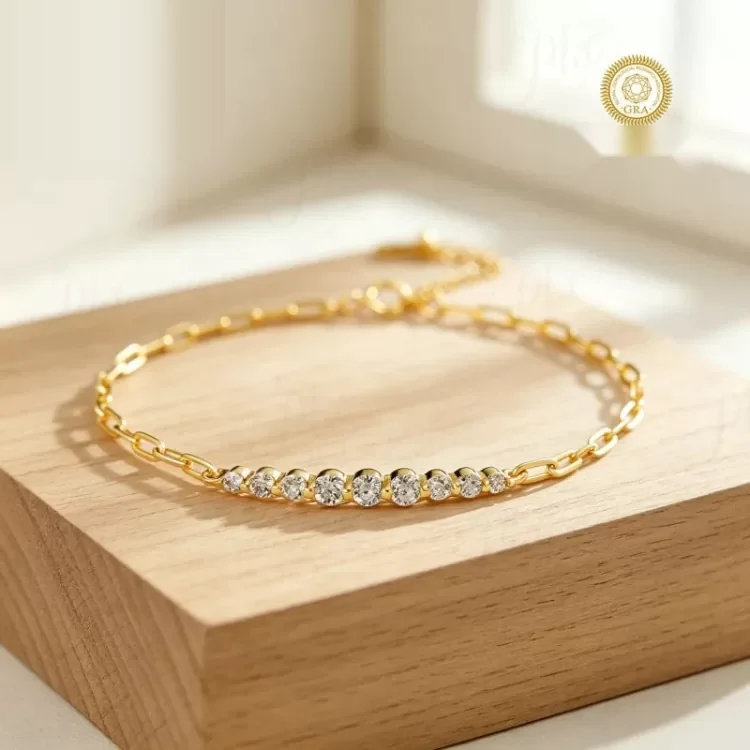
Wholesale Bracelets: GRA/IGI Certificate Verification

Why Certificate Verification Matters When Sourcing Wholesale Bracelets
Bracelets are one of the most requested categories in the moissanite jewelry segment, and buyers who verify certificates before placing an order protect themselves against misgraded stones, swapped goods, and shipment disputes. When you evaluate wholesale bracelets, the paperwork attached to each stone is as important as the setting and the metal.
A GRA or IGI report that can be matched to the actual stones on your bracelet gives you a defensible quality standard, a pricing reference, and a document you can pass along to your own retail customers. This article walks through the practical decisions involved in certificate verification for wholesale bracelet orders, from checking report numbers at the sampling stage to organizing paperwork for bulk shipments.
What GRA and IGI Papers Actually Cover
GRA Reports for Moissanite
GRA papers are widely used for moissanite stones, including the loose stones set into tennis bracelets, bangles, and charm designs. A GRA report typically identifies the stone as moissanite rather than a natural diamond, and it records characteristics such as color grade, cut shape, carat weight, and measurements. The document includes a report number that corresponds to the stone, which allows you to confirm that the paper in the box describes the stone on your bench.
Because moissanite is a lab-created diamond alternative, the report language should clearly reflect that identity; any paper that implies the stone is a natural diamond is a red flag worth raising with your supplier before money changes hands.
IGI Reports and When They Apply
IGI is an established grading laboratory whose reports are also used for graded stones in the bracelet category. IGI documentation follows a similar structure: an identification of the stone type, graded characteristics, and a report number tied to the item. For wholesale buyers, IGI papers can be useful when selling to retail partners who recognize the lab name and want documentation from an independent grading body.
Both GRA and IGI papers serve the same core function in a bracelet transaction: they create a written record of what was supplied, so that your incoming inspection team has a benchmark to measure against.
Reading a Report Number and Matching It to the Stone
Verification starts with the report number. On a bracelet, stones are small and numerous, so the practical approach is to request papers for the stones at the agreed grades and to spot-check report numbers against the physical goods. Some bracelets are supplied with a certificate for the center or feature stones; others, such as full tennis bracelet designs, may be accompanied by documentation covering the total carat weight of the layout.
Ask your supplier before sampling how papers are issued for the specific design, because a three-stone charm bracelet and a twenty-stone tennis bracelet are documented differently.
Building Certificate Verification Into Your Ordering Process
Certificate verification should not be an afterthought at the shipping stage. The most effective buyers fold it into every phase of the order, from the first sample to the pre-shipment inspection. The table below gives a stage-by-stage view you can adapt to your own workflow.
| Order Stage | Verification Action | What to Check | Timing |
|---|---|---|---|
| Sample request | Review sample papers | Report number, stone type, grades | 7 to 10 days sampling |
| Bulk approval | Confirm paper format | Coverage per stone or per bracelet | Before production starts |
| In-process QC | Match stones to grades | Color and cut against report | During 15 to 25 day production |
| Pre-ship AQL | Spot-check papers | Report numbers against goods | Before balance payment |
| US delivery | File paperwork on arrival | Papers match packing list | 5 to 8 days DDP transit |
Each stage builds on the previous one. A report number confirmed at the sampling stage gives you a reference for the production run, and a reference for the production run makes the pre-ship inspection meaningful. Skipping the sample-stage check leaves you with nothing to compare bulk goods against, which is where most disputes begin.
How Three-Stage QC Supports Verified Papers
Incoming Inspection of Loose Stones
Graded stones used in bracelets are sold by the carat and arrive with GRA or IGI papers. Incoming inspection is the first quality control gate: stones are checked on arrival against the documented carat weight and grade before they are released to the setting floor. If a stone does not match its paper, it is pulled at this stage rather than discovered after it has been set.
For buyers, this matters because a stone verified at intake is far easier to replace than a stone verified after setting.
In-Process Checks During Bracelet Production
Once stones are set, in-process quality control examines the bracelet itself. Inspectors confirm that the stone placed in each setting corresponds to the documented layout, and they check settings, clasps, and links for workmanship. On tennis bracelets, where dozens of small stones sit in a continuous line, this stage catches substitution errors and loose settings before assembly is finished. Buyers who review in-process photos and inspection notes gain an early view of consistency across the production run.
Pre-Shipment AQL Inspection
The third stage is a pre-shipment AQL inspection conducted before the balance payment is released. This is the natural point to include certificate verification in the inspection checklist: the inspector pulls bracelets at random, checks the goods, and confirms that the accompanying GRA or IGI papers match the report numbers recorded at sampling.
Because payment terms are structured as a T/T 30 percent deposit and 70 percent balance before shipment, holding certificate verification inside the AQL stage gives buyers a concrete checkpoint tied to the final payment. Sample orders paid through PayPal follow the same verification logic on a smaller scale.
Common Verification Mistakes Wholesale Buyers Make
Trusting Papers Without Cross-Checking Goods
A certificate in a box is not evidence until it matches the stone it claims to describe. Buyers who verify report numbers at sampling and again at pre-ship inspection build a paper trail that holds up if a claim arises later. If you receive a bracelet whose paper describes a different carat weight or grade than the stone on the piece, flag it immediately and reference the sampling-stage record.
Accepting Papers That Mislabel the Stone
Moissanite is a lab-created diamond alternative, and legitimate GRA and IGI papers describe it as such. Any document that calls the stone a natural diamond or omits the stone type is a signal to stop and ask questions. Similarly, check the metal description on the paperwork: it should name the actual material, such as 925 sterling silver, 10K/14K/18K solid gold, gold vermeil, or gold plated. Plated and vermeil pieces should be documented as such, never described as solid gold.
Skipping Verification on Repeat Orders
Buyers who verified certificates on a first order sometimes relax on reorders. Consistency across repeat orders is exactly what a documented verification process is designed to enforce. Keep the report numbers from your approved sample on file and require the same reference points on every replenishment run, whether the reorder is one piece of a stock style or a 30-piece custom production.
Practical Decisions: Papers, Pricing, and Payment Terms
Several commercial decisions tie directly to certificate verification. First, decide whether you need per-stone papers, per-bracelet papers, or both, and confirm the format before approving bulk production. Second, understand how papers affect pricing: because stones are priced per piece or per carat depending on the item, a documented grade is what justifies the quoted price. Third, sequence your verification against your payment schedule.
With a 30 percent deposit by T/T to start production, the 70 percent balance due before shipment, and PayPal available for sample orders, the verification milestones should line up as follows: sample papers reviewed before the deposit, bulk papers spot-checked during AQL before the balance, and full paperwork filed on arrival within the 5 to 8 day DDP transit window to the US.
Minimum order quantities shape the decision as well. Stock bracelet styles can be ordered at a minimum of 1 piece, which lets you test the paperwork process on a small scale before committing to custom work at a minimum of 30 pieces. Sampling runs 7 to 10 days, and bulk production takes 15 to 25 days after approval, so building verification steps into these timelines costs little extra time and prevents expensive rework later.
Order Terms for Wholesale Buyers
MOQ is 1 piece for stock styles and 30 pieces for custom work, and loose stones are sold by the carat. Sampling takes 7 to 10 days, and bulk production runs 15 to 25 days after the sample is approved. Pricing is quoted per piece or per carat depending on the item. Payment is T/T with a 30% deposit and the 70% balance before shipment, and PayPal is accepted for sample orders.
Frequently Asked Questions
Do all bracelet stones come with certificates?
Graded stones come with GRA or IGI papers, while smaller accent stones may be documented differently depending on the design. Ask before sampling how papers are issued for your specific bracelet, whether per stone, per layout, or as a total carat weight document. Getting this confirmed in writing at the sampling stage avoids ambiguity at shipment.
How do I check that a GRA or IGI report number matches my bracelet?
Record the report numbers from your approved sample, then have the pre-shipment AQL inspection spot-check production pieces against those numbers. Compare the documented carat weight, color, and cut to the physical stones on the piece. Any mismatch should be resolved before the balance payment is released.
Can I use GRA and IGI papers in my retail packaging?
Yes. Many wholesale buyers pass the papers along with the bracelet as part of the retail presentation, since documentation supports the customer's confidence in the stone. Make sure the paper identifies moissanite as a lab-created diamond alternative and names the metal accurately, so your retail claims stay consistent with the documentation.
Does certificate verification slow down the order timeline?
Not noticeably. Sampling takes 7 to 10 days and bulk production runs 15 to 25 days after approval, and verification steps fit inside those windows. Reviewing sample papers and adding a paper check to the AQL inspection add minimal time compared to the cost of a dispute after delivery.
What happens if a stone does not match its paper?
A mismatch caught at incoming inspection or in-process QC is the easiest case, because the stone is still loose or the bracelet is still on the line. A mismatch found at pre-ship AQL should be documented and resolved before the balance payment is sent. This is why the verification checkpoints are tied to each stage of quality control and to the payment schedule.
Next Steps for Buyers Sourcing Certified Bracelets
Certificate verification comes down to three habits: confirm paper format before sampling, match report numbers at the AQL stage, and file the paperwork on arrival. Those steps fit inside the standard production timeline and give you a documented basis for pricing, quality claims, and retail presentation. If you are ready to review bracelet designs with full GRA and IGI documentation, start by browsing the bracelet category on our product catalog to see available stock and custom styles.
For more guidance on stone grading, QC stages, and wholesale buying workflows, read the guides on our wholesale jewelry blog. When you have a design in mind, request a quote and sampling details through our contact page and we will confirm paper format, pricing per piece or per carat, and delivery timelines for your market.
Sources: Grading references: GIA gem education and GIA laboratory information.